


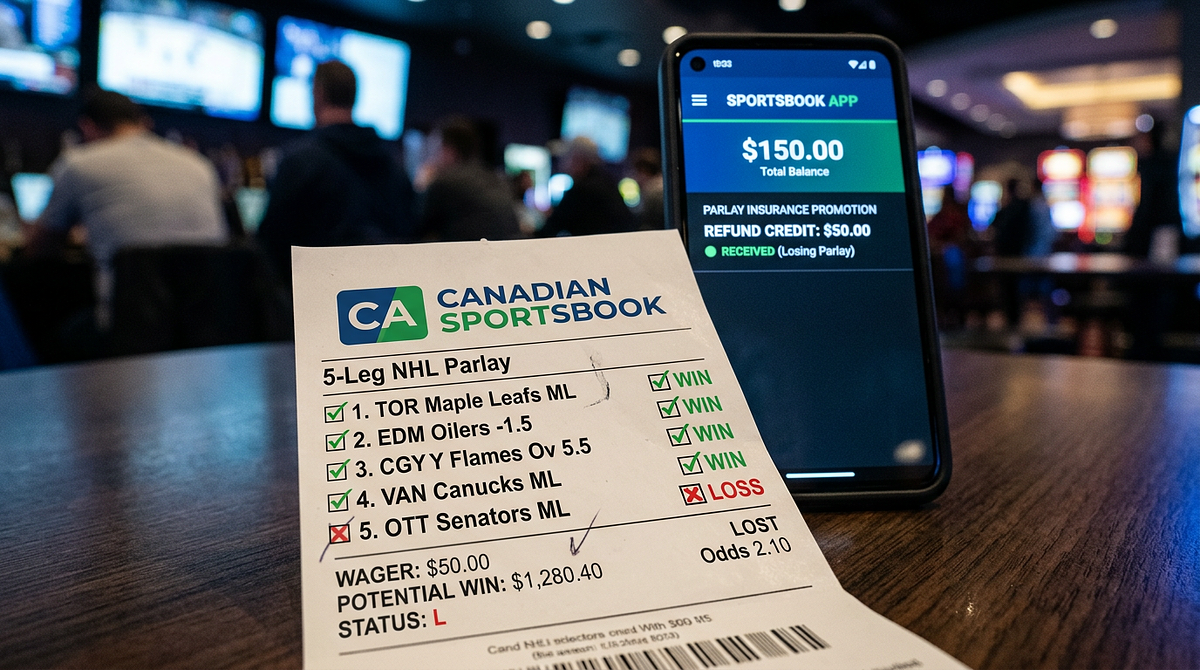
Parlay insurance promotions in Canada are more specific than they might look at first. The refund only kicks in when a parlay misses by exactly one leg, not just when any leg fails. How the sportsbook grades each leg matters too, since a push or no-contest result gets removed from the ticket rather than counted as a loss, which affects whether the trigger condition is met. This page explains how the trigger works, what eligibility thresholds apply, and what form the refund takes once a ticket qualifies. By the end, you’ll have enough information to decide whether a specific promotion is worth factoring into your betting decisions.
Parlay Insurance Defined for Canadian Bettors
Parlay insurance is a sportsbook promotion that returns a partial refund when a multi-leg parlay ticket loses by exactly one leg. It’s designed to soften the blow of a near-miss parlay, where every selection wins except one. This section covers what the promotion is and what counts as a qualifying loss. Eligibility thresholds, refund caps, and edge cases are covered separately below.
The “Exactly One Leg Loses” Trigger Condition
Parlay insurance is triggered only when a single leg on the ticket settles as a loss and every other leg settles as a win. A ticket where two or more legs lose does not qualify, no matter how close the parlay came to winning. The sportsbook looks at the fully settled ticket after all legs have graded, and only issues a refund if exactly one leg lost.
This matters because bettors often assume a “close” parlay qualifies, when the promotion only responds to one specific loss pattern. If two legs lost, the promotion was never in play because the trigger condition was never met.
Site Credit Versus Bonus Bet Refunds
Parlay insurance refunds come as either site credit or bonus bets, not withdrawable cash. This affects the real value of the promotion. A bonus bet returns only the net profit on a winning wager, not the face value of the token itself. Site credit may carry its own withdrawal and rollover restrictions set by the sportsbook.
Two promotions with the same headline refund figure can be worth different amounts depending on which refund form applies. A CAD $25 bonus bet and a CAD $25 site credit are not the same thing, because the bonus bet’s face value is consumed when you place the wager and doesn’t come back to your account if you win. If you only look at the headline number without checking the refund form, you’ll get an inaccurate picture of what the promotion is worth.
Here’s how the two refund forms compare on the things that matter most:
- Site credit: funds added to your account balance, with sportsbook-defined restrictions on withdrawal and rollover.
- Bonus bet: a stake-not-returned token where a winning wager pays only the net profit, not the token’s face value.
Eligibility Conditions That Determine Whether a Parlay Qualifies
Two types of eligibility rules determine whether a parlay can access a refund under an insurance promotion: minimum leg count and minimum odds per leg. Both vary across sportsbook offers and are set independently. A parlay that loses by exactly one leg can still be disqualified if it fails either test. You need to understand both before placing a ticket with the expectation of insurance coverage.
Minimum Leg Count Requirements
Most parlay insurance promotions require a minimum number of legs on the ticket. Three legs is a common lower boundary, but some offers set the floor at five or more. A parlay placed below that threshold doesn’t qualify for the refund no matter how narrowly it loses. A two-leg ticket that loses by one leg gets nothing under an offer requiring four legs minimum.
The leg-count minimum connects directly to expected value because the sportsbook’s margin compounds across every leg added to a parlay. A shorter qualifying parlay carries less accumulated vig than a longer one, which means a fixed-dollar refund offsets a proportionally larger share of the negative expected value on a three-leg ticket than on a six-leg ticket.
This changes how you should read a “generous” promotion. A lower leg-count minimum is a more meaningful condition than a higher refund cap, because it determines the quality of the underlying bet the insurance attaches to. An offer requiring only three legs with a CAD $25 refund cap delivers more practical value than an offer capping the refund at CAD $50 but requiring six legs, because the shorter parlay starts from a less disadvantaged position before the insurance is factored in.
Minimum Odds Per Leg
Beyond leg count, sportsbooks commonly set a minimum-odds condition on each individual leg of the parlay. This floor stops bettors from meeting the leg-count minimum by stacking heavy favourites (selections priced so short they carry near-certain implied probability), which would otherwise reduce the parlay’s risk while still qualifying for the insurance refund.
The practical result is that a parlay can meet the leg-count requirement and lose by exactly one leg, yet still be disqualified because a single leg was priced shorter than the odds floor. The sportsbook checks every leg independently against the threshold, not the parlay as a whole. One non-qualifying leg is enough to void the entire ticket‘s eligibility, even if every other leg clears the requirement.
This makes the odds floor a silent disqualifier. A bettor who builds a ticket around the leg-count minimum and the one-leg-loss trigger, but overlooks the per-leg odds condition on one selection, loses the refund with no visible warning at the time of placement. Every leg on a parlay-insurance-eligible ticket must independently clear the odds threshold. There’s no averaging across legs and no partial qualification.
Refund Amounts and Common Caps
Parlay insurance promotions have two separate constraints that determine how much value you can recover. The first is a dollar ceiling that limits the refund on any single qualifying parlay. The second is a daily or per-offer limit that restricts how many parlays can attract that coverage within a given day. Together, these constraints define the real boundaries of the promotion, which the headline framing of “get your money back” doesn’t make explicit.
The $25 Refund Ceiling as an Industry Norm
The refund cap on parlay insurance promotions is almost always $25 across Canadian-facing sportsbooks, with some offers as low as $5 and some reaching $50. BetMGM’s parlay insurance and FanDuel’s NHL Parlay Insurance both cap the refund at $25.
The cap sets the maximum you can recover regardless of stake size. A bettor who places a $200 parlay and loses by one leg gets back no more than a bettor who placed a $25 parlay under the same offer. The refund doesn’t scale with the amount wagered.
This reframes what the promotion delivers. The headline language of recovering your stake implies proportional protection, but the fixed dollar ceiling means the promotion works as a flat-value token, not a percentage-based safety net. Staking above the cap adds exposure without adding any corresponding insurance coverage.
Daily Qualifying Parlay Limits
Sportsbooks commonly cap the number of parlays that can attract insurance coverage within a single day. FanDuel’s NHL Parlay Insurance, for example, applies a maximum refund of $25 per day, which in practice means one qualifying parlay per day under that offer.
Placing multiple parlays on the same day doesn’t automatically extend insurance coverage across all of them. The promotion covers one specific parlay, and any additional parlays placed that day sit outside that coverage regardless of how they settle.
This matters because bettors who are active across several games or markets in a single session may assume their overall parlay exposure is insured. It’s not. The daily limit ties the protection to one defined parlay position, making the promotion narrower in scope than its general framing suggests.
Push and No Contest Outcomes on a Parlay Leg
Pushed legs and no-contest outcomes are treated differently from losses in parlay settlement, and that difference has direct consequences for how parlay insurance is applied. When a leg pushes or is voided, it’s not treated as a losing leg. It’s removed from the ticket entirely. Bettors who expect a push to trigger insurance because a leg “didn’t win” are misreading how settlement works. The right starting point is understanding the difference between a removed leg and a lost leg.
How a Pushed or No Contest Leg Is Removed and Odds Recalculated
When a parlay leg pushes or is voided due to a no contest or draw, the sportsbook drops that leg from the ticket and recalculates the payout using the remaining valid legs at adjusted odds. FanDuel Ontario’s house rules state that the payout is recalculated removing the voided or pushed legs. Caesars Ontario specifies that Caesars parlay bet rules recalculate odds based on the remaining valid legs. PointsBet Canada states that the overall price of the parlay is recalculated excluding the pushed leg. The parlay doesn’t lose that leg. The leg simply ceases to exist on the ticket.
A five-leg parlay containing one pushed leg becomes, in effect, a four-leg parlay at adjusted odds with a lower potential payout. Because the pushed leg is removed rather than graded as a loss, the insurance trigger (which requires exactly one leg to settle as a loss) is not activated by the push. If you’re reading a settled ticket that contains a pushed leg, interpret the payout figure as a recalculated result across fewer legs, not as an insurance-eligible near-miss where one leg failed to contribute.
Distinguishing a Loss From a Void for Insurance Purposes
The insurance mechanic depends entirely on how each leg is graded. A loss counts toward the ticket’s loss total and, when exactly one loss appears across the remaining legs, may satisfy the trigger condition if all other eligibility requirements are met. A void or push doesn’t count toward that total at all. It’s dropped from the ticket before the loss count is evaluated.
A parlay that contains one losing leg and one pushed leg is not a “one-leg-loses” ticket in the insurance sense. The correct way to read it is to remove the pushed leg first, then evaluate the loss count on the legs that remain. Whether insurance applies is determined by the outcome of that reduced ticket, not by the original leg count. A bettor who skips the void-removal step and counts the pushed leg as a second outcome will misread the settlement and draw the wrong conclusions about eligibility.
The three possible settlement outcomes for an individual parlay leg each carry a different consequence for insurance eligibility:
- Win: the leg counts toward the parlay and pays at its individual odds.
- Loss: the leg counts toward the parlay’s loss total and, at exactly one loss across the ticket, may trigger insurance if all other eligibility conditions are met.
- Push or no contest: the leg is dropped from the ticket, the remaining legs recalculate the payout, and the leg does not count toward the insurance trigger.
Expected Value and How Eligibility Thresholds Shape It
Parlay insurance doesn’t exist in isolation from the math of the parlay itself. The refund it offers works against a backdrop of compounding vig that reduces the expected value of every multi-leg ticket before any promotion is applied. Understanding how eligibility thresholds interact with that compounding is what tells you whether a given parlay insurance offer meaningfully offsets your exposure or just provides a nominal cushion on a deeply negative-value wager.
Compounding Vig on Longer Parlays
Each leg of a parlay carries a built-in margin for the sportsbook (the vig), and that margin doesn’t simply add across legs. It multiplies. A two-leg parlay compounds the vig twice. A five-leg parlay compounds it five times, producing a materially lower expected return per dollar staked than a shorter ticket at equivalent individual odds. The longer the parlay, the wider the gap between the fair-odds payout and the actual payout the sportsbook offers.
This matters for parlay insurance because the refund is fixed in dollar terms, typically capped at CAD $25, regardless of how many legs the ticket contains. On a longer parlay, the compounding vig has already eroded a larger share of the ticket’s expected value, so a flat CAD $25 refund offsets a smaller proportion of that erosion than it would on a shorter ticket. The insurance doesn’t scale with the vig. The vig scales with the leg count.
The eligibility conditions attached to a parlay insurance offer carry direct expected-value consequences. A promotion that requires five or more legs pushes the bettor into a range of the parlay-length spectrum where compounding vig is at its steepest, which means the fixed refund cap recovers a smaller fraction of the negative expected value than the same cap would on a three-leg ticket.
Why Lower Leg Minimums Produce Higher Expected Value
A parlay insurance offer with a three-leg minimum applies its refund to a ticket that has accumulated less compounding vig than a five-leg ticket would carry. The shorter parlay starts from a less negative expected-value position, so the same fixed refund (say, CAD $25) represents a proportionally larger offset against your total exposure. The leg-count minimum is not a neutral administrative requirement. It directly determines the vig environment in which the insurance operates.
Two offers with identical CAD $25 refund caps are not equivalent if their leg-count minimums are different. A three-leg-minimum offer at a CAD $25 cap pairs a modest refund with a parlay that carries relatively contained compounding vig. A five-leg-minimum offer at the same CAD $25 cap pairs the same refund with a parlay that has compounded vig across two additional legs, producing a wider gap between expected value and the refund’s recovery power. The dollar figure on the cap is the same. The expected-value context it operates within is not.
The eligibility threshold is the primary variable in assessing what a parlay insurance offer delivers. Comparing two offers solely by their refund cap, without accounting for the leg-count minimum each imposes, gives you an incomplete picture of the value each offer provides relative to the vig you absorb to qualify for it.
Reading a Parlay Insurance Offer Correctly Before You Bet
The practical value of a parlay insurance offer is determined not by its headline refund figure but by how the trigger condition, the eligibility thresholds, and the refund form all interact. If you understand all three, you can read the fine print of any such promotion and accurately assess whether a given ticket would qualify, what form any refund would take, and how the leg-count minimum shapes the vig environment the insurance operates within.
We check operator terms, licences and payment details against the casino's own pages and update this content when they change. Read our editorial policy, our transparency statement, or report an error. If gambling stops being fun, see our responsible gambling resources.