
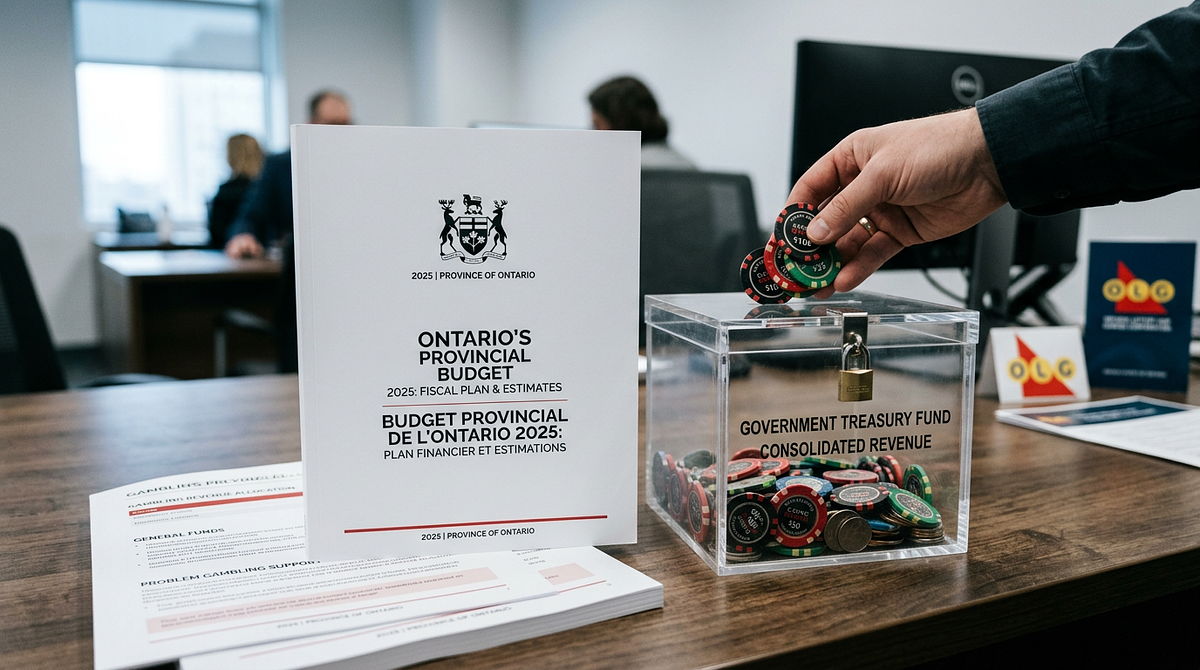
Ontario doesn’t have a dedicated problem gambling fund. Gambling revenues flow into the province’s Consolidated Revenue Fund alongside regular tax income, with no money set aside for specific purposes.
This article traces how that money moves, what share reaches harm reduction programs, how gambling-related harm is distributed among players, and where independent research funding currently stands. Keep reading to get a clear picture of how Ontario structures its approach to problem gambling and where the accountability gaps are.
How Ontario Routes Gambling Profits Through the Provincial Treasury
Since 2000, Ontario has treated gambling profits the same as tax revenue, depositing them into the Consolidated Revenue Fund to be spent on general budget priorities. Lottery profits from OLG, casino proceeds, and dividends from iGaming Ontario all go into the same pool as personal income tax, corporate tax, and sales tax.
No law requires any portion of that money to go toward problem gambling treatment, prevention, or harm reduction. That foundation shapes how harm-reduction funding gets decided each fiscal year.
The General Revenue Pool Model and Its Implications for Earmarking
Lottery and casino profits enter Ontario’s Consolidated Revenue Fund the same way income and sales tax do. OLG documents this as payments made available to the fund, and iGaming Ontario’s financial statements confirm the agency transfers most of its earnings as a dividend to the same fund: C$181 million in dividend payments in fiscal 2024–25 alone.
Once that money is deposited, it’s interchangeable with every other dollar in the fund and gets allocated through the standard provincial budget process.
There’s no dedicated problem gambling budget line attached to this revenue. In practical terms, that means funding for treatment or prevention has to compete every year against health, education, transportation, and every other spending priority.
No formula protects it based on how much gambling revenue came in. The amount directed to harm reduction in any given year comes down to the discretionary judgment of the Ministry of Finance and the relevant portfolio ministries, not a calculation tied to gambling revenue volume.
The structural result is that harm-reduction funding has no automatic connection to the scale of harm-generating activity. If online wagering doubles, the treatment budget doesn’t go up by the formula. If gambling participation drops, nothing prevents the budget from being cut.
Why the Routing Model Resembles General Taxation
Academic and policy analysts treat Ontario’s gambling revenue model as structurally no different from general taxation. The mechanism is the same: a government-controlled revenue stream flows into a common pool and gets allocated through annual budget decisions, with no link between where the money came from and what it’s spent on.
A Cardus policy brief makes this point directly, noting that the post-2000 treatment of gambling profits is functionally a tax architecture with a different label.
Gambling profits have accounted for between 4% and 5% of total Canadian government revenues since 2008. That puts gambling in the category of meaningful but not dominant revenue. It’s large enough to matter in budget planning, but not so large that the province is structurally dependent on it in a way that would force trade-offs against harm-reduction policy. It’s closer to a sizeable excise category than a foundational revenue pillar.
The Scale of Gambling Revenue and the Allocations Directed to Harm Reduction
Three figures define the fiscal scale of gambling in Ontario for the most recent reporting period. Total wagering by Ontarians across in-person and online channels exceeded C$150 billion, with the regulated online market alone accounting for approximately C$98.3 billion in wagers during the 2025 calendar year and C$82.7 billion in fiscal 2024–2025.
Provincial taxes paid by online gambling operators in 2025 are estimated at approximately C$807 million, based on Ontario’s 20% tax rate applied to iGaming Ontario’s reported revenue. Voluntary spending by the online gambling industry on responsible gambling campaigns has been reported at approximately C$23 million for 2025. These three numbers are the inputs for the allocation analysis below.
Voluntary Industry Spending Relative to Provincial Tax Intake
Voluntary industry spending on responsible gambling campaigns, reported at approximately C$23 million in 2025, works out to roughly 2.85% of the estimated C$807 million in provincial taxes paid by online operators that year. Put another way, for every C$100 the province collected in online gambling tax, the industry directed about C$2.85 toward voluntary harm-reduction campaigns.
The C$23 million figure isn’t confirmed by iGaming Ontario’s annual report, AGCO disclosures, or other Ontario-specific primary documents identified to date, so treat that ratio as indicative rather than audited.
The distinction between voluntary and mandatory spending matters here. Voluntary spending means discretionary outlays by operators on public messaging, tool awareness, and campaign sponsorship. Mandatory contributions would be statutory or regulatory levies tied to revenue or licence conditions and directed into ring-fenced harm-reduction or treatment funds.
iGaming Ontario’s financial statements confirm that operator earnings are transferred as a dividend to the Consolidated Revenue Fund, but available disclosures don’t establish the dollar value of any mandatory operator contribution to harm reduction. For a detailed breakdown of how Ontario’s iGaming market is structured and how revenues flow through the regulated system, the regulatory framework explains the two-body split between AGCO and iGaming Ontario.
Without a published mandatory contribution figure, the voluntary ratio above is the only operator-side spending indicator that can be quantified against tax intake for 2025.
Funding for Treatment, Prevention, and Harm Reduction Programs
The most recent verifiable allocation tied to treatment, prevention, and harm reduction is the C$303 million over three years committed in the 2025 Ontario Budget for community mental health and addictions agencies.
The Canadian Mental Health Association Ontario described this as a 4% increase in operational funding. This envelope covers community mental health and addictions care broadly, and budget documents don’t isolate a separate dollar figure for problem gambling treatment within it.
Annualized, the commitment averages approximately C$101 million per year across all community mental health and addictions services in the province, of which problem gambling treatment is one piece.
Whether problem gambling treatment funding specifically has grown in proportion to online gambling expansion cannot be established from available documents.
The regulated online market launched in April 2022 and grew to approximately C$98.3 billion in wagers by calendar 2025, but no published Ontario budget line tracks problem gambling treatment funding as a separate time series against that growth.
On prevention, Canada’s lower-risk gambling guidelines recommend gambling no more than 1% of pre-tax household income per month and no more than four days per month. These are designed to inform public health prevention messaging.
How formally Ontario has integrated these guidelines into provincial prevention campaigns, and whether there’s dedicated funding for youth-specific problem gambling programming, isn’t documented in available sources.
The Concentration of Gambling Revenue Among Problem and At-Risk Players
Research on gambling economics consistently finds that a small minority of consumers generate most of the revenue. A widely cited pattern shows roughly 80% of gambling revenue comes from the top 20% of most engaged consumers, with the ratio skewing further for specific products like high-frequency electronic gaming machines and online betting.
This concentration is the central data point for assessing the ethics of government-sponsored gambling, because it defines how much public revenue is produced by the smallest and most intensive segment of the player base. The shape of that distribution, not the headline revenue total, determines how the harm profile of gambling intersects with the fiscal model.
What the Revenue Concentration Ratio Means for Public Policy
If a substantial share of gambling revenue comes from problem and at-risk players, then the province’s general revenue pool is partly financed by harm.
Academic literature treats this as a defining ethical issue for government-sponsored gambling, because the state simultaneously regulates the activity, captures its proceeds, and funds the services that respond to its consequences.
The relevant policy question is whether harm-reduction allocations are calibrated to the share of revenue derived from harmed players, or whether they’re set at levels disconnected from that proportion.
Ontario’s routing model offers no formula linking the two. iGaming Ontario transfers earnings as a dividend into the Consolidated Revenue Fund, and harm-reduction spending competes annually against unrelated budget priorities. No statutory mechanism scales treatment or prevention funding to the volume of revenue produced by the most intensive players.
Product-category differences compound the issue. Research shows that high-frequency electronic products and online betting concentrate revenue more sharply among the heaviest users than slower-paced formats like draw-based lotteries.
The 2022 launch of Ontario’s regulated online market shifted a growing share of provincial gambling activity into precisely the categories where that concentration is steepest, with no documented adjustment to the balance between harm-generating revenue and harm-reduction allocations.
Estimating the Prevalence of Problem Gambling in Ontario
Two prevalence figures are in active circulation, and they’re nearly an order of magnitude apart. The 2018 Canadian Community Health Survey, analyzed by Statistics Canada and published in 2022, found that 1.1% of Canadians were at moderate-to-severe risk for gambling problems. Ontario-specific reporting has applied that figure to the provincial population.
A more recent study, cited by Carleton University researchers and still awaiting peer review, reported a problem gambling rate closer to 9% in Ontario in the period just before the April 2022 launch of the regulated online market.
The gap comes down to methodology. Population health surveys like the CCHS rely on broad self-report instruments embedded in general health questionnaires, which tend to produce lower prevalence estimates.
Targeted screening studies using gambling-specific instruments administered to gambling populations tend to produce higher rates. The 9% figure hasn’t cleared peer review and should be treated as preliminary.
The 1.1% figure is tied to 2018 data collected before the regulated online market existed and may understate the current prevalence. Neither figure, on its own, gives a current and methodologically settled estimate of problem gambling prevalence in Ontario. Players looking for practical support can review responsible gambling tools and resources available to Canadian players, including deposit limits, self-exclusion options, and national support programs.
Online Gambling Expansion and the Independent Research Funding Gap
The April 2022 launch of iGaming Ontario’s regulated online market introduced a revenue stream that has scaled rapidly across three fiscal years, generating dividend payments to the Consolidated Revenue Fund alongside operator tax contributions. That fiscal expansion hasn’t been paired with any announced provincial funding for independent research to monitor how online gambling affects problem gambling prevalence.
This is the third structural gap in Ontario’s harm-management approach, alongside the routing gap (no ring-fencing of gambling profits) and the allocation gap (harm-reduction spending that remains small relative to total gambling revenue and tax intake).
The monitoring gap is distinct because it concerns the evidentiary basis on which the other two gaps can be measured at all.
The Revenue Trajectory of Regulated Online Gambling
The regulated online market recorded over C$82.7 billion in wagers and C$2.9 billion in total gaming revenue during its third year of operation, fiscal 2024–2025, according to iGaming Ontario’s annual report. For the 2025 calendar year, total wagers reached approximately C$98.3 billion, and combined in-person and online wagering by Ontarians exceeded C$150 billion.
Online operators paid approximately C$807 million in provincial taxes in 2025, a figure derived by applying Ontario’s 20% tax rate to reported revenue rather than disclosed as a primary line item.
The harm profile of online gambling is different from land-based formats in three documented ways: higher session frequency, continuous 24-hour access, and product features like in-play betting that compress the time between placing a wager and seeing the outcome. These differences change what monitoring requires.
Prevalence surveys conducted on multi-year cycles, calibrated to a pre-online gambling environment, don’t capture the behavioural patterns introduced by always-available digital products. A market operating at this scale, with this product mix, generates a research and surveillance requirement that older monitoring instruments weren’t designed to meet.
The Absence of Dedicated Independent Research Funding
As of January 2025, the Ontario government had not announced any funding for independent research to monitor the impact of online gambling expansion on problem gambling rates, according to analyses published in The Conversation and Medical Xpress.
This sits against a longer policy trajectory: the province eliminated funding for gambling research in 2019, after which the Gambling Research Exchange Ontario restructured into Greo Evidence Insights. Greo’s 2025–2026 call for Indigenous-led community impact projects represents harm-prevention programming, not dedicated monitoring research tied to the post-2022 online market.
Public health literature treats research funded outside both industry channels and the regulator as a precondition for credible harm monitoring.
The reasoning is structural: an entity that derives revenue from gambling, or that licenses operators, has a financial or regulatory interest in what prevalence research finds, and that interest creates a documented risk of selection bias in research questions, methodologies, and publication decisions.
The question of who currently monitors online gambling harm in Ontario, and on what funding basis, doesn’t resolve to a single named institution drawing on stable provincial funding. Ontario’s self-exclusion framework is one area where regulatory obligations are more clearly defined — how Ontario’s centralized self-exclusion system works through BetGuard and GameSense illustrates the player protection tools that licensed operators are required to enforce.
Available sources confirm the absence of an announced provincial research line. They don’t confirm the existence of an independently funded body filling that role at the scale the market would warrant.
Evaluating Whether Funding Levels Match the Documented Scale of Harm
Three structural gaps emerge when you read the preceding sections together. The routing gap places gambling profits inside the Consolidated Revenue Fund with no statutory ring-fencing for harm reduction, meaning treatment and prevention compete annually against every other budget priority.
The allocation gap leaves voluntary industry spending and provincial harm-reduction budgets small relative to the scale of wagering and tax revenue documented earlier. The monitoring gap is defined by the absence of any announced independent research funding tied to the expansion of the regulated online market since April 2022.
With these three gaps established, the question of whether funding is proportionate to documented harm is one you can answer directly from the underlying figures rather than from interpretive framing.
A Side-by-Side View of Revenue Flows and Harm-Reduction Allocations
The following table consolidates the financial figures established earlier in the article into a single evaluative view.
|
Fiscal Indicator |
Reporting Period |
Amount (CAD) |
Source Type |
|---|---|---|---|
|
Total wagered by Ontarians through the regulated online market |
Calendar year 2025 |
Approximately C$98.3 billion |
Regulator market data (iGaming Ontario, reported via Yahoo Finance) |
|
Provincial taxes paid by online gambling operators |
2025 |
Approximately C$807 million (derived estimate at the 20% provincial rate) |
Derived estimate from regulator revenue figures |
|
Voluntary industry spending on responsible gambling campaigns |
2025 |
Reported figures suggest a range of C$23 million, not confirmed by an Ontario-specific primary source. |
Industry disclosure (unverified) |
|
Provincial allocation to community mental health and addictions agencies (treatment envelope, addictions broadly) |
2025 Budget, three-year envelope |
C$303 million over three years |
Provincial budget (Ontario Budget 2025, via CMHA Ontario) |
|
Provincial allocation is identified as a distinct line for prevention and harm reduction specific to problem gambling |
Most recent fiscal year |
Available data indicate that no distinct line is published; prevention funding sits inside the broader addictions envelope above |
Provincial budget |
|
Announced funding for independent research on online gambling harm |
2025 |
C$0 announced |
Government announcement record (The Conversation, Medical Xpress, January 2025) |
What the Numbers Reveal About Ontario’s Harm-Reduction Priorities
When C$2.9 billion in annual online gaming revenue is weighed against a C$303 million three-year addictions envelope, the structural imbalance is hard to ignore. Because gambling profits flow into the Consolidated Revenue Fund rather than any dedicated harm-reduction stream, addiction support has to compete annually against every other provincial priority. That’s a design choice with real consequences for how seriously those harms get addressed. No independent research funding has been announced, leaving a significant gap in accountability.
For anyone tracking how these figures shift over time, monitoring iGaming Ontario, OLG, and provincial budget disclosures is the most reliable way to stay current. Comparing those updates against the figures in the table above will sharpen the picture. For a broader context on how Ontario’s online casino market operates and what licensed operators are required to offer players, the provincial regulatory framework sets the baseline for both commercial activity and player protection obligations.