

If you’re trying to figure out what documents Ontario casinos need to verify your identity, this guide breaks it down clearly. It covers the four main document categories operators ask for: photo ID, proof of address, payment method verification, and source of funds. It also covers the age and location checks that happen at registration and during play. By the end, you’ll know what to prepare and why each document gets asked for.
The Regulatory Framework Behind Ontario Online Casino Verification
Ontario’s regulated online gaming market launched on April 4, 2022, and it runs under a two-body provincial structure. The Alcohol and Gaming Commission of Ontario (AGCO) is the provincial regulator that handles licensing and standards. iGaming Ontario (iGO) is the conduct-and-management body that runs the regulated market on behalf of AGCO and manages the relationship with registered operators.
Federal anti-money-laundering rules sit on top of that provincial structure. Registered operators also have to comply with the Proceeds of Crime (Money Laundering) and Terrorist Financing Act (PCMLTFA), administered by the Financial Transactions and Reports Analysis Centre of Canada (FINTRAC). This two-layer setup, provincial conduct rules plus federal AML rules, shapes how verification requirements are structured.
Identity Verification Routes Available to Ontario Players
When you register with a regulated Ontario operator, your identity gets confirmed through one of two paths. The first is an automated credit-file match, which runs silently in the background by checking your registration details against Canadian credit bureau data.
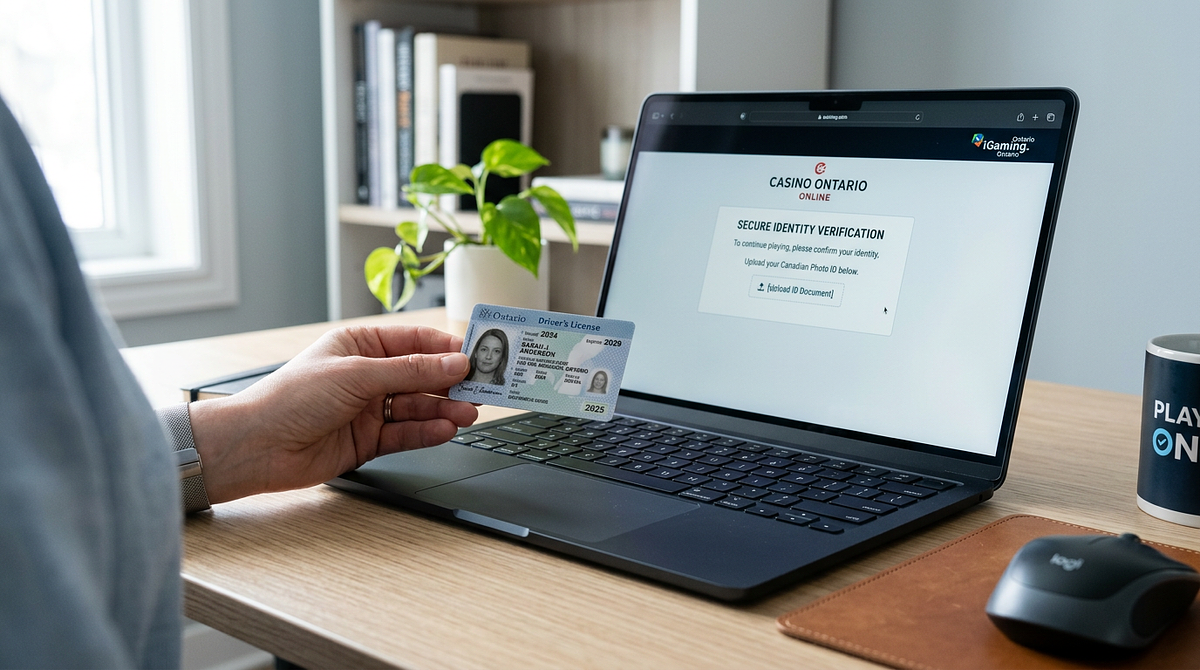
The second is a document upload, which kicks in when the credit-file check fails or doesn’t return enough data to confirm who you are. The document upload path is the one most players notice, because it means you have to find, photograph, and submit files. The next section covers which documents are accepted for that route.
How the Credit File Match Route Works
This route works by matching the name, address, and date of birth you entered at registration against credit bureau records held by agencies like Equifax Canada and TransUnion Canada. FINTRAC recognizes two credit-file approaches under the PCMLTFA.
The first is the single credit file method, which requires a Canadian credit file that has existed for at least three years and includes more than one tradeline. The second uses a credit file as one of two sources under the dual-process method, where the file only needs to have existed for at least six months. When this route works, you won’t be asked to upload any documents at registration. Most licensed operators in Ontario rely on credit bureau data for their FINTRAC-compliant checks, so this is the path most players go through.
When Document Upload Becomes Required
A few situations will push you into the document-based route. The most common is a thin or non-existent Canadian credit history, which affects newcomers to Canada, young adults who just turned 19, and people who rarely or never use credit.
A mismatch between what you entered at registration and what’s in your credit file, such as a wrong date of birth or a significant address discrepancy, will also trigger the fallback. Some operators will escalate certain accounts to manual review based on their own internal risk scoring. This isn’t a punishment. Document upload is simply the regulated backup path for identity verification when the credit file method can’t return a clean result.
Government-Issued Photo ID Accepted for Document-Based Verification
When the credit-file route isn’t available or doesn’t work, your photo ID becomes the anchor document for the verification file. The ID you submit needs to be current (not expired on the date you upload it) and genuine, meaning it can be confirmed as a real document issued by a recognized authority.
Regulated Ontario operators are required to capture and keep specific data fields from the document image. That’s why the quality, legibility, and validity of the ID you submit determines whether the upload passes or gets sent back. For a broader look at what the AGCO Registrar’s Standards require from licensed Ontario operators, the full compliance obligations go well beyond identity checks alone.
Accepted Photo ID Document Types
Regulated Ontario operators accept a specific set of photo ID documents for the document-based verification route. You can choose whichever one you currently hold, as long as it’s unexpired and free of physical damage or anything blocking the text. The list below shows what you can submit to satisfy the photo ID requirement.
- Canadian passport — current and unexpired, photo page submitted.
- Provincial driver’s licence — front and back of the card, name and address matching your registration details, accepted as a primary driver’s license document.
- Government-issued photo identification card — any current federal or provincial government-issued ID that meets authenticity standards.
- Provincial photo card alternative — the non-driver provincial photo card available to residents who don’t hold a driver’s licence, used as an equivalent primary ID.
Data Fields the Operator Records From the Document
When document-based verification is used, the operator is required to record and keep a specific set of fields from the document you submitted. Those fields are your full name as it appears on the document, the document type, the document number, the province or country of issue, the expiry date, and the date verification was completed.
This record has to be kept for at least five years from the date it was created. It’s also why expired documents, blurry images, or IDs with obscured corners get rejected. If any required field can’t be read clearly, the operator can’t close the verification file.
Proof of Address Requirements
Proof of address is a separate document from your photo ID, and operators ask for it even when your ID already shows a residential address. The point is to confirm you actually live at the address on your account, using a second independent document from a third party. Ontario operators apply a freshness rule to this category: the document typically needs to be dated within the last three months. Older documents get rejected because they don’t reliably show where you currently live.
Accepted Proof of Address Documents
Several common household documents qualify, as long as they show your full name, the residential address on your account, and an issue date within the three-month window. Here are the document types most Ontario operators accept.
- Utility bill — electricity, gas, water, or internet bill issued within the last three months showing your name and address.
- Bank or credit card statement — official statement dated within the last three months, with transaction details optionally redacted.
- Government correspondence — tax notice, benefit statement, or other official letter dated within the last three months.
- Lease or mortgage document — current residency document showing your name and the address on file.
Payment Method Verification at the Withdrawal Stage
Some Ontario operators ask for an extra document confirming you own the deposit and withdrawal method before they release your first withdrawal. This step is separate from identity verification. It happens at the withdrawal stage, not at registration, so you can sign up, fund your account, and play before the request comes up.
The purpose is to connect your already-verified identity to the specific financial instrument moving money in and out of your account. Identity verification confirms who you are. Payment method proof confirms that the card, bank account, or e-wallet being used belongs to you and isn’t someone else’s.
What Payment Method Proof Typically Looks Like
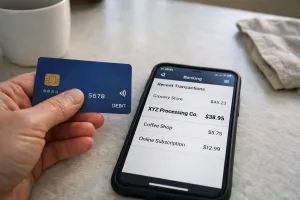
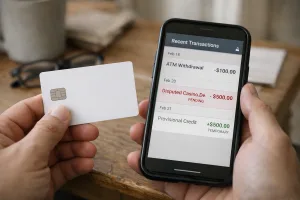
What operators ask for depends on how you funded your account. For card payments, the standard submission is a photo of the physical card with the middle digits and the CVV covered, leaving the cardholder name and last four digits visible. For bank transfers or e-wallets, operators typically ask for a screenshot or statement showing the account holder’s name alongside the account identifier, whether that’s an IBAN, account number, or wallet ID.
The name on the document has to match the verified identity on your gaming account. A payment method registered in someone else’s name will be rejected and can trigger an account review. Not every operator requires this step for every withdrawal. When it gets triggered depends on the operator’s own risk policy.
Source of Funds Verification for Elevated-Risk Transactions
Source of funds verification is a deeper level of due diligence that most players never run into. It’s separate from the identity and address checks done at registration, and it gets triggered later by transaction thresholds or risk-based factors rather than being a default step when you open an account.
When it is triggered, the operator asks you to show where the money you’re wagering came from, not just who you are, but how those funds were earned or acquired. Under federal rules, a casino must verify identity and file a disbursement report when paying out C$10,000 or more in a single transaction. Suspicious or unusually large transactions can also trigger extra scrutiny regardless of size. The history of why these rules exist is well illustrated by what the Cullen Commission found about money laundering in BC casinos, which documented how hundreds of millions in criminal proceeds moved through gambling venues when source of funds checks were inadequate.
What Triggers a Source of Funds Request
A few things can move an account into source of funds review. Cumulative deposits or withdrawals crossing operator-defined thresholds are a common cause, as are single transactions at or above the C$10,000 disbursement reporting threshold.
Deposit patterns that look out of step with your declared occupation or income range will also escalate the file. Hits during the politically exposed person, sanctions, and adverse media checks that operators run on their player base create another trigger. Ongoing monitoring, which happens at minimum monthly intervals, can also flag accounts whose behaviour has shifted from their initial risk profile.
Documents Accepted as Source of Funds Evidence
Source of funds documents need to credibly explain how the money got into your account. Operators check what you submit against your stated occupation, income, and declared net worth. If the documents don’t line up with that profile, expect follow-up requests or account restrictions. Here are the document categories operators typically accept.
- Recent pay stubs — covering the most recent two to three pay cycles from your employer.
- Employer letter or employment contract — confirming role, salary, and tenure.
- Tax assessment or filed return — most recent year, showing declared annual income.
- Bank statements covering deposit activity — typically three to six months showing the inflow being wagered.
- Documentation of a one-time event — inheritance papers, property sale records, or investment liquidation statements where a large balance has a non-salary origin.
Age and Location Verification at Registration
Ontario sets the legal gambling age for regulated online play at 19, and operators enforce that through the photo ID check done during account registration. The date of birth captured from your government-issued document, whether through automated credit-file matching or document upload, is what stops underage access.
Alongside identity, operators also have to confirm you’re physically inside Ontario when you play. That’s handled by geolocation technology running alongside the identity checks. These two requirements work on different schedules: age is verified once at registration and treated as settled, while location is checked continuously every time a session starts and throughout active play.
How Geolocation Confirms Ontario Residency at Play Time
Geolocation software pulls together multiple signals from your device to confirm you’re inside Ontario’s borders. Your IP address gives a baseline network location, GPS data is read where you’ve granted device-level permission, Wi-Fi triangulation matches nearby access points against mapped coordinates, and mobile network data adds cell-tower positioning on smartphones.
These inputs are combined to produce a position fix that the platform checks against the provincial boundary each time a session starts. A session started from outside Ontario gets blocked even if your account is fully verified. VPN traffic is detected and rejected by the same system. A verified Ontario account won’t work while you’re travelling outside the province. The regulated platform is geofenced to Ontario. Players who want to understand the full legal picture of where Ontario-licensed sites stand can read more about how online gambling is regulated and what is legal in Ontario.
Additional Verification Layers for Higher-Risk Scenarios
The four-document framework, photo ID, proof of address, payment method confirmation, and source of funds evidence, covers most Ontario accounts. But operators can apply further verification steps when an account, a transaction, or a behavioural pattern raises risk indicators that the standard checks don’t resolve.
These steps, which can include biometric verification or enhanced identity checks, are exception paths triggered by specific signals rather than steps every player goes through. The trigger conditions are set by each operator’s risk policy within the parameters AGCO and FINTRAC require.
Selfie and Biometric Checks
A selfie or biometric verification request usually involves a live photo or a short video of you, sometimes paired with you holding your submitted ID next to your face. The image gets processed through facial-matching technology that compares it against the photo on the document already on file.
Some Ontario operators ask for this at registration as a standard step, but it more commonly shows up as an escalation when document authenticity is uncertain, when a credit-file match returns a mismatch, or when an account shows signs of unauthorized access like a login from an unfamiliar device. This is the most invasive verification step a typical Ontario player will encounter, and refusing to complete it will generally result in your account being frozen pending review.
Preparing Your Documents Before You Register
Most Canadian players clear identity verification automatically through a credit-file match and never upload a single document, which makes the whole process feel invisible until it suddenly isn’t. When manual review does kick in, usually at withdrawal, having nothing ready is what causes delays.
A current photo ID, proof of address from the last three months, a payment document matching your verified name, and source-of-funds evidence for larger deposits will cover nearly every scenario an operator can throw at you. Getting these together before you fund an account takes minimal effort and pays off when it matters most. If you’re still choosing where to play, reviewing the best Ontario online casinos can help you identify regulated operators with clear verification processes. Check the operator’s verification page now to confirm exactly what they require.
We check operator terms, licences and payment details against the casino's own pages and update this content when they change. Read our editorial policy, our transparency statement, or report an error. If gambling stops being fun, see our responsible gambling resources.