

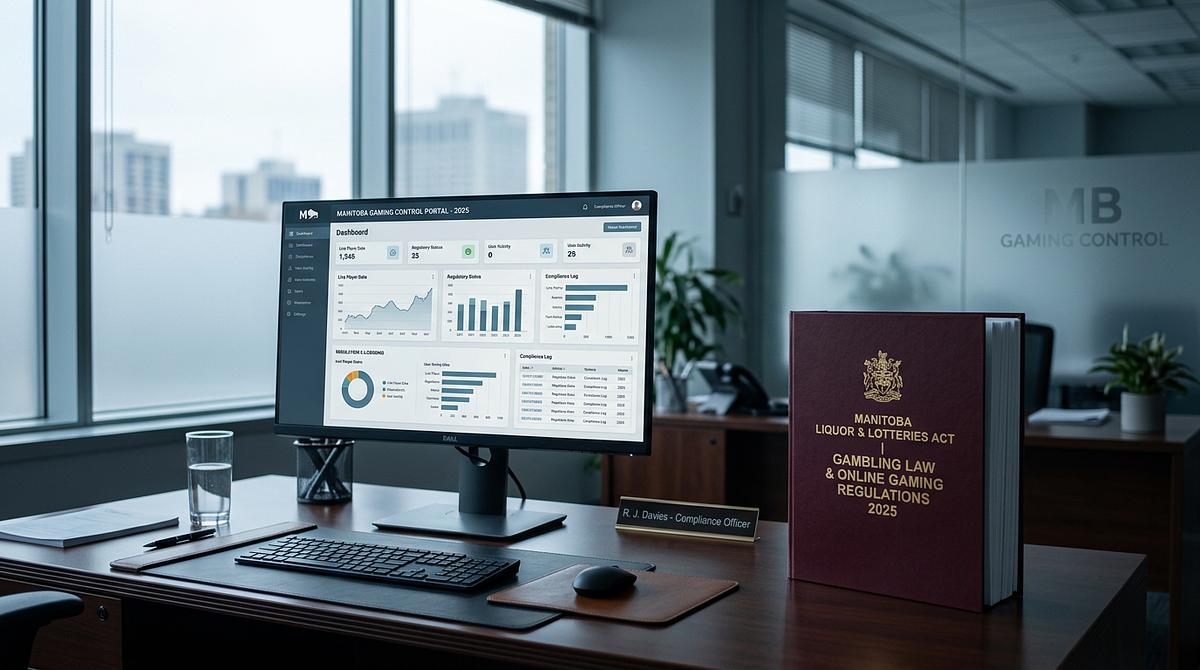
Manitoba gambling law gives a single Crown corporation exclusive authority to run online gaming in the province. That authority flows from section 207(1) of the Criminal Code of Canada and is backed by two provincial statutes: CCSM c L155 and CCSM c L153. This page breaks down that legal foundation, explains what MBLL does as the operator versus what the LGCA does as the regulator, identifies PlayNow.com as the only authorized platform, and covers enforcement against offshore sites alongside FINTRAC anti-money-laundering rules.
The Legal Foundation of Provincial Control Over Online Gaming
Online gaming in Manitoba operates under a two-tier legal structure. At the federal level, section 207(1) of the Criminal Code of Canada prohibits gambling in the country except when a provincial government conducts and manages it. That carve-out is what makes legal online gambling possible anywhere in Canada. At the provincial level, Manitoba exercises that authority through two statutes: The Manitoba Liquor and Lotteries Corporation Act (CCSM c L155) and The Liquor, Gaming and Cannabis Control Act (CCSM c L153), which came into force on 17 October 2018. Together, these two laws create a Crown monopoly model.
The Federal Criminal Code Carve-Out for Provincial Conduct and Management
The “conducted and managed” standard in section 207(1) works as an exclusivity clause. Gambling is a criminal offence in Canada by default, and this provision creates one narrow exception: a provincial government, acting directly or through an authorized agent, can lawfully conduct and manage a lottery scheme. The province is not a licensor handing out permits to private operators. It is the entity legally responsible for running the gaming activity itself.
In practice, no private operator, whether based in Canada or offshore, can lawfully offer real-money gambling to Manitoba residents unless it acts as the province’s authorized agent. A licence from Malta, Curaçao, the Isle of Man, or any other foreign jurisdiction carries no legal weight against this federal requirement. Foreign regulatory approval does not substitute for provincial conduct and management, which is why offshore sites accepting Manitoba players are treated as unauthorized regardless of where they are licensed.
Manitoba’s Provincial Statutory Framework
Manitoba uses two statutes rather than one because it separates operational authority from regulatory oversight. The first statute establishes the provincial Crown corporation and gives it exclusive authority to conduct and manage lottery schemes in the province, including online gaming and designated video lottery terminal sites. This is how the federal conduct-and-management authority gets exercised on the ground in Manitoba.
The second statute establishes the independent licensing and compliance regulator. It also replaced two older pieces of provincial gaming legislation: The Gaming Control Act (S.M. 1996, c. 74) and The Gaming Control Local Option (VLT) Act (S.M. 1999, c. 44), both of which were superseded when the new regulatory statute took effect in October 2018.
Splitting the framework across two acts means the operator cannot regulate itself. The entity that runs gaming cannot also be the entity that licenses gaming activities or audits compliance. That separation is a structural safeguard, not just an administrative choice.
The Operator: The Provincial Crown Corporation’s Mandate
Manitoba Liquor & Lotteries (MBLL) is the provincial Crown corporation that holds operational authority over gaming in Manitoba. It was formed in 2013 through the merger of the Manitoba Liquor Control Commission and the Manitoba Lotteries Corporation. Its enabling statute was enacted on 5 December 2013 and brought into force on 1 April 2014. MBLL’s exclusive mandate covers four gaming categories: land-based casino operations, provincial lottery products, video lottery terminals at designated sites, and online gaming. No other entity, public or private, holds parallel authority to conduct any of these activities for Manitoba residents.
Scope of Exclusive Operational Authority
MBLL directly conducts and manages every category of provincially authorized gaming in Manitoba. That includes the two Winnipeg casinos it operates, the provincial lottery product line, video lottery terminals at designated sites, and online gaming through the province’s single authorized platform. The corporation can also conduct, manage, or operate a gaming event on behalf of someone who holds a gaming event licence issued under The Liquor, Gaming and Cannabis Control Act.
“Conducting and managing” is a legal term drawn from section 207(1) of the Criminal Code of Canada. It means MBLL is the operator of gaming activity in Manitoba, not a licensor issuing permits to private operators.
This structure is different from Ontario’s competitive iGaming model, launched in April 2022 through iGaming Ontario, where multiple private operators enter commercial agreements with a provincial subsidiary and deliver products directly to Ontario residents. Alberta introduced Bill 48, the iGaming Alberta Act, in 2025 to build a similar competitive framework. Manitoba has not gone either route.
Online Gaming Revenue as an Indicator of Market Scale
MBLL reported C$75.9 million in online gambling revenue for the 2024–2025 fiscal year, a 1.5% increase over the prior year. That figure represents the total value generated through the province’s single authorized online channel and gives a concrete sense of the regulated online market’s size in Manitoba. It does not capture what Manitoba residents spend on unauthorized offshore platforms, which sits outside the reported provincial figures and outside the conduct-and-management framework.
The Regulator: The Independent Licensing and Compliance Authority
Manitoba’s online gaming regime puts licensing and compliance oversight in a body that is separate from the operator. That body is the Liquor, Gaming and Cannabis Authority of Manitoba (LGCA), established under The Liquor, Gaming and Cannabis Control Act, CCSM c L153. The LGCA does not conduct or manage gaming, hold player accounts, or run any gambling product. Its authority is limited to licensing eligible activities, checking the technical integrity of games and equipment, and monitoring compliance across the regulated environment. Manitoba Liquor & Lotteries runs the province’s gaming; the LGCA supervises the rules under which regulated gaming happens.
Regulatory Remit and the Operator-Regulator Separation
The LGCA has three core functions. First, it licenses charitable gaming activities and issues gaming event licences to eligible applicants. Second, it checks the technical integrity of games and gaming equipment used in the province, including standards applied to devices and software before they enter regulated play. Third, it monitors ongoing compliance across the regulated gaming environment and applies enforcement measures when licensed activity departs from the terms of authorization.
A community organization, service club, or event organizer that wants to hold a gaming activity, such as a raffle, bingo, or similar fundraising event, must apply to the LGCA for a gaming event licence. That licensing authority rests with the regulator, not with Manitoba Liquor & Lotteries, even though the Crown corporation may in some cases conduct, manage, or operate a gaming event on behalf of a licence holder under CCSM c L155.
Keeping conduct-and-management separate from licensing and compliance oversight stops the operator from regulating its own conduct. That separation is the structural safeguard that protects the integrity of the provincial gaming framework. For a closer look at how Manitoba online casino options compare in practice, including how PlayNow stacks up against offshore alternatives available to residents, the province hub covers the key differences.
The Authorized Online Platform
PlayNow.com is the only legal online gambling site available to Manitoba residents. The platform launched in the province in January 2013 and is operated by Manitoba Liquor & Lotteries under a service provider arrangement that uses the British Columbia Lottery Corporation’s technology. Saskatchewan joined the same platform in 2022, extending the arrangement to three western Canadian provinces. The multi-province partnership lets Manitoba, British Columbia, and Saskatchewan share a common technical infrastructure, a shared peer-to-peer poker network, and pooled operational scale, while each province keeps authority over the conduct and management of gaming for its own residents.
Product Categories and Age Eligibility
PlayNow.com offers three categories of real-money products to Manitoba residents: casino-style games, lottery products, and sports wagering. Casino games are delivered through the shared BCLC-powered platform and include table games, slots, and peer-to-peer poker on a network connecting players across the participating provinces. Lottery products sit alongside the platform’s digital catalogue and the physical lottery distribution network operated by MBLL. For more detail on how the BCLC-powered platform works and what makes it government-regulated, see this complete guide to PlayNow in British Columbia.
The minimum legal gambling age in Manitoba is 18. Account registration on PlayNow.com is restricted to confirmed Manitoba residents who have reached that age.
Single-event sports betting became legal in Manitoba on 27 August 2021, the date PlayNow.com turned on single-game wagering. That change was made possible by Bill C-218, federal legislation amending the Criminal Code of Canada, which passed on 29 June 2021. Before that amendment, provincial operators could only lawfully offer parlay-style bets involving multiple outcomes.
The Status of Daily Fantasy Sports Under Current Regulation
Daily fantasy sports platforms, including operators like DraftKings and FanDuel, are accessible to Manitoba residents and are not currently restricted under provincial gambling regulation. This sits alongside MBLL’s exclusive online gaming mandate rather than conflicting with it. The current treatment reflects a regulatory classification that puts daily fantasy sports in a different category from online casino gaming and sports wagering. It is not a gap in the framework. As a result, the exclusivity that applies to online casino and sports betting through PlayNow.com does not extend to daily fantasy sports contests offered by third-party operators.
Enforcement Against Unauthorized Offshore Operators
In 2025, Manitoba Liquor & Lotteries shifted from a passive enforcement posture, relying on the federal Criminal Code’s prohibition to deter offshore operators, to an active civil-enforcement posture. The Crown corporation is now testing whether provincial civil remedies can constrain offshore sites that federal criminal law has not effectively deterred in practice. The tool it chose is a targeted civil injunction against a specific offshore operator, rather than a broader legislative or network-level intervention. That choice reflects both the operator’s assessment of its available legal tools and the judicial history of provincial attempts to restrict access to unlicensed gambling sites elsewhere in Canada.
The 2025 Civil Injunction Filing
In February 2025, Manitoba Liquor & Lotteries filed an application in the Manitoba Court of King’s Bench against Bodog, an offshore operator running bodog.eu and related sites. The application alleged that Bodog was offering online gambling products and services to people in Manitoba without provincial authorization, in violation of the province’s regulatory framework and section 207(1) of the Criminal Code of Canada. The remedy sought was injunctive relief: an order restraining Bodog from continuing to operate and advertise gambling services directed at Manitoba residents.
The court granted the injunction on 27 May 2025. It declared that Bodog had no lawful authority to offer online gambling products or to advertise to people in Manitoba, and ordered the companies operating bodog.eu and bodog.net to stop targeting Manitoba residents. For any offshore site that accepts Manitoba players, the practical consequence is a court order, enforceable through Canadian civil process, directing it to exit the provincial market. That is separate from any parallel exposure under federal criminal law.
Comparative Precedent on Provincial Enforcement Limits
The civil-injunction route also reflects the constitutional limits set by earlier provincial enforcement attempts. In 2016, Quebec enacted Bill 74, which required internet service providers to block access to online gambling websites not on a government-backed list of authorized sites. The Quebec Court of Appeal struck down the site-blocking mechanism, following an earlier Superior Court ruling that found the scheme unconstitutional. The decision confirmed that provinces cannot compel ISPs to filter internet traffic as a way of restricting access to unlicensed gambling operators. For a full account of how that legal challenge unfolded and why the courts struck it down, see the detailed breakdown of Quebec’s failed ISP blocking law Bill 74.
That precedent explains why Manitoba Liquor & Lotteries is pursuing a civil remedy against a specific named operator rather than pushing for a legislative site-blocking regime. Network-level blocking of offshore sites is not a legally available tool for a Canadian province. Targeted civil action against an identified operator is.
Anti-Money-Laundering Obligations Under Federal Reporting Rules
Manitoba Liquor & Lotteries is the sole designated reporting entity to the Financial Transactions and Reports Analysis Centre of Canada (FINTRAC) for all casino, online gaming, and designated video lottery terminal activity in the province. The reporting scope covers Club Regent Casino, McPhillips Station Casino, three First Nations casinos, Shark Club Gaming Centre, VLT sites with more than 50 terminals, and PlayNow.com. This concentration of reporting responsibility under a single provincial entity reflects the conduct-and-manage structure established under section 207(1) of the Criminal Code of Canada. Federal obligations attach to MBLL directly rather than to any private licensee, because no private licensee exists within Manitoba’s gaming framework.
Reportable Transaction Thresholds
FINTRAC applies fixed monetary thresholds to specific casino transaction categories. Crossing any of these values requires MBLL to file a report with the federal agency. The table below sets out the values that trigger a reporting obligation.
| Transaction Category | Threshold Value | Measurement Window |
|---|---|---|
| Jackpot wins (single or aggregated) | C$10,000 or more | 24-hour period |
| Chip or slot ticket redemption or purchase (aggregated) | C$10,000 or more | 24-hour period |
| Chip or slot ticket purchase (single transaction) | C$3,000 or more | Single transaction |
How Manitoba’s Model Compares to Other Canadian Provincial Approaches
Canadian online gaming regulation is fragmented by province, not set at the national level. At least two distinct models are now in operation or under active development across the country: the exclusive Crown-operator model, where a single provincial corporation conducts and manages all legal online gaming, and the competitive private-operator licensing model, where multiple licensed private operators deliver the product under provincial oversight. Alberta introduced Bill 48, the iGaming Alberta Act, in 2025, proposing a competitive licensing framework modelled on Ontario’s approach. Manitoba’s exclusive Crown model is one deliberate policy choice among several currently in play across Canada, not a default national standard.
The Two Dominant Canadian Provincial Models
The two models share parallel structural dimensions: who operates, who regulates, how many operators are permitted, and which provinces have adopted each approach. The table below sets those out for direct comparison. For a closer look at how Alberta built its competitive framework and whether it genuinely mirrors Ontario’s approach, see this analysis of whether Alberta’s private iGaming market will follow Ontario’s model.
| Dimension | Exclusive Crown-Operator Model | Competitive Private-Operator Licensing Model |
|---|---|---|
| Who conducts and manages gaming | A single provincial Crown corporation (e.g., MBLL in Manitoba) | A provincial Crown subsidiary holds the conduct-and-manage authority while licensed private operators deliver the product (e.g., iGaming Ontario) |
| Who licenses and regulates | A separate independent provincial regulator (e.g., LGCA in Manitoba) | The Alcohol and Gaming Commission of Ontario (AGCO) regulates operators; iGaming Ontario, an AGCO subsidiary, enters into operating agreements with private operators |
| Number of legal online operators | One authorized Crown platform (e.g., PlayNow.com) | Multiple licensed private operators (over 50 registered in Ontario as of 2024) |
| Example province(s) | Manitoba, British Columbia, Saskatchewan | Ontario; Alberta (proposed under Bill 48, 2025) |
What Manitoba’s Exclusive Online Gaming Regime Means for Legal Play in the Province
The Bodog injunction of 27 May 2025 makes clear that Manitoba is not just maintaining its Crown monopoly on paper. It is actively defending it through civil litigation. That enforcement posture, combined with PlayNow.com’s sole authorized status under section 207(1) of the Criminal Code, makes Manitoba’s model one of the most tightly controlled in Canada. Ontario has moved toward licensed private operators and Alberta has proposed a similar path, but Manitoba’s LGCA-regulated framework deliberately holds a different course. For players and operators alike, understanding exactly where legal authority sits and how it gets enforced is the practical starting point, which is what the comparative breakdown above shows.
We check operator terms, licences and payment details against the casino's own pages and update this content when they change. Read our editorial policy, our transparency statement, or report an error. If gambling stops being fun, see our responsible gambling resources.