

Jackpot City has been around for 25 years, but the Canadian market looks very different in 2026 than it did in 1998. Ontario now runs its own provincial iGaming framework, most other provinces are covered by a Kahnawake licence, and Alberta launched its own provincial framework on 13 July 2026. This page looks at four things that determine whether the site is worth your time: licensing, bonus terms, game selection, and withdrawal speed. By the end, you should have enough to decide whether Jackpot City still makes sense for Canadian players in 2026.
Licensing and Regulatory Standing for Canadian Players in 2026
Canadian online casino regulation isn’t one unified system. Two provinces now run their own iGaming markets with their own oversight bodies — Ontario since April 2022 and Alberta since 13 July 2026 — while players in every other province are covered by a long-standing Indigenous gaming licence. The same operator can hold licences under both systems at once, so which rules apply to you depends on where you live. Each system has different oversight, enforcement, and ways to resolve disputes, so it’s worth knowing which one covers you before you sign up.
Provincial Regulated Framework Coverage
Ontario is one of two Canadian provinces running its own regulated iGaming market. The regulator is iGaming Ontario (iGO), which operates under the authority of the Alcohol and Gaming Commission of Ontario (AGCO). Jackpot City entered this market in June 2022 under the entity name Cadtree Limited, and Cadtree Limited appears on the iGaming Ontario operator registry as of June 2026. Ontario’s regulated market recorded 2.1 million active player accounts and CAD 82.7 billion in total wagers across 49 registered operators in the 2024-25 fiscal year. For Ontario residents, “regulated in Canada” means something specific: the operator is subject to AGCO standards and iGO contractual obligations. That level of provincial accountability doesn’t extend to players outside Ontario.
Rest-of-Canada Licensing Coverage
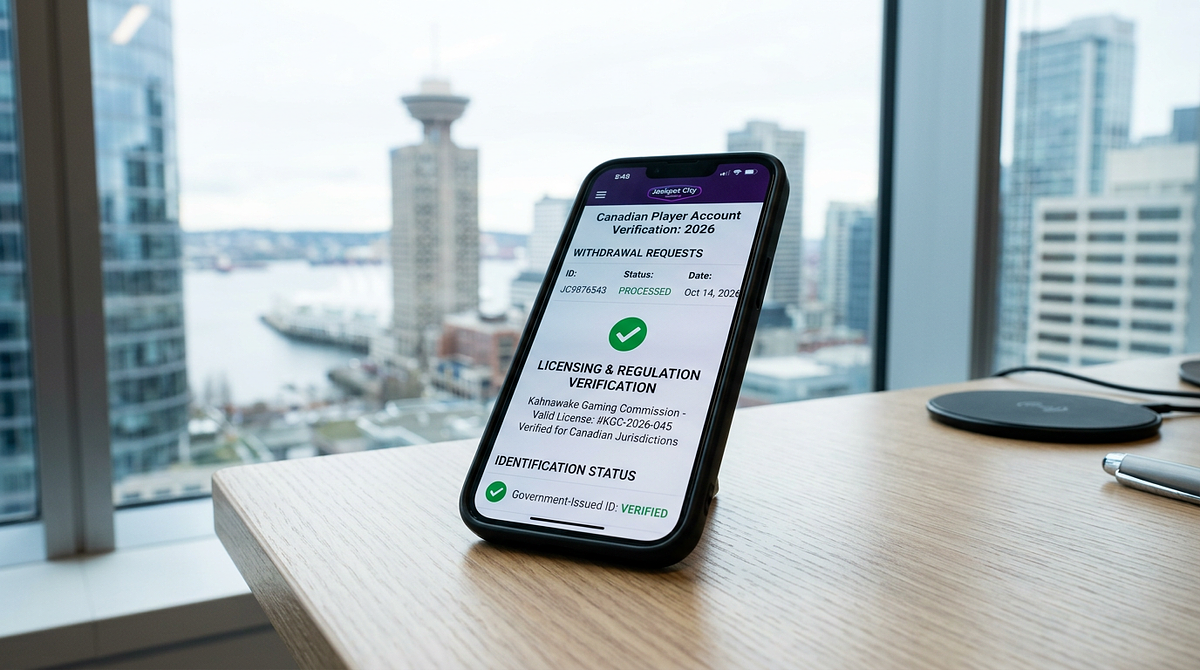
Players outside Ontario are covered by a Kahnawake Gaming Commission licence. Pre-research records cite the licence number as 00892, though that number could not be independently confirmed against the Kahnawake Gaming Commission’s published registry. Jackpot City has operated under Kahnawake licensing since it launched in 1998, which is over 25 years of continuous operation under this system. The Kahnawake framework has published standards and is widely recognised, but it sits outside any provincial consumer-protection system. That means the dispute process and enforcement options available to you are materially different from what Ontario players can access.
Corporate Ownership and Global Operational Scale
Jackpot City is owned by Super Group, a publicly listed holding company. Super Group’s 20-F Annual Report records 5.0 million average monthly active customers for the year ended 31 December 2025 for Betway specifically, not for the group as a whole (group-level monthly actives were 5.5 million in Q3 2025), up from 4.4 million in 2024, according to the company’s 20-F Annual Report filed in April 2026. Because Super Group is publicly listed, its operational and financial disclosures are subject to securities reporting obligations. That creates a layer of corporate accountability that privately held operators don’t have. It doesn’t resolve questions about individual player experience, but it does mean there’s a verifiable paper trail that doesn’t exist for operators without public-market reporting requirements.
Regulatory Expansion into the Western Provincial Market
Alberta passed Bill 48 in May 2025, which opens the door to a regulated iGaming market in the province. Super Group confirmed a multi-brand Alberta entry strategy that includes Jackpot City, with an initial regulated launch date set for July 13, 2026. Later reporting pointed to a revised timeline of September 2026 or later, though that revised date could not be confirmed from a primary source at the time of writing. Super Group’s CEO stated on February 25, 2026 that the company is ready to launch across all brands. That puts Jackpot City in position to operate under a third Canadian regulatory framework as Alberta’s market takes shape, extending its regulated footprint beyond Ontario into a second provincially governed environment.
Current Welcome Bonus Structure and Wagering Terms
The headline number on a welcome bonus doesn’t tell you much on its own. What determines whether a bonus is worth taking is the wagering requirement attached to it, and those vary depending on which landing page you land on and when. Jackpot City’s current offer combines deposit-match cash and free spins across a stacked structure, and the wagering requirements span a wide enough range to produce very different outcomes depending on which tier applies to you.
Headline Offer Composition
The current welcome package offers up to C$1,600 in deposit bonuses combined with 450 free spins. This is spread across multiple qualifying deposits, not a single transaction. The C$1,600 ceiling isn’t something you can unlock from one deposit. Each qualifying deposit unlocks a portion of the total, so the advertised sticker value and the amount available from any single deposit are two different numbers.
Wagering Requirements and How to Read Them
Wagering requirements on Jackpot City’s welcome offer range from 35x to 70x depending on the specific landing page and promotion tier. A wagering multiplier means you take the bonus amount and multiply it by that number to get the total you need to wager before any winnings from the bonus can be withdrawn. A C$100 bonus at 35x requires C$3,500 in qualifying wagers. The same bonus at 70x requires C$7,000. Standard offers in 2026 tend to sit closer to the 35x to 50x end of that range than previously higher tiers. That shift matters: the same headline bonus at 35x gives you roughly twice the realistic chance of withdrawing compared to 70x. When you’re looking at any specific landing page, treat the wagering multiplier as the number that matters, not the cash ceiling.
Game Library Scale and Return-to-Player Reporting
Title counts and published RTP figures show up in almost every casino review, but both are easy to misread. A headline title count tells you how big the library is, not how good the games are. An aggregate RTP figure describes a theoretical long-run average across the whole catalogue, not what you should expect in any single session. Both are rough reference points, not guarantees. The site’s biggest attraction gets its own dedicated breakdown — Mega Moolah’s win history at Jackpot City is documented separately.
Catalogue Scale and Cited Title Counts
Casino.ca’s Jackpot City review, dated July 1, 2026, cites a library of 1,500+ titles, a figure that appears consistently across multiple casino.ca pages indexed in July 2026. An earlier figure of approximately 450 titles appears in pre-research records but could not be confirmed from any available 2026 source, so the 1,500+ count is the most current verifiable reference point. Title counts vary across published reviews because reviewers count differently. Live dealer tables, game variants, and regionally restricted titles get included or excluded inconsistently, so any headline figure reflects the reviewer’s methodology as much as the actual inventory. Catalogue size alone doesn’t tell you anything about gameplay quality or how deep any specific game category goes.
Published Return-to-Player Figures
Casino.ca attributes an aggregate RTP of 97.39% to Jackpot City as of July 2026. Aggregate RTP is a theoretical long-run average calculated across the covered catalogue. It describes expected return over an extremely large number of wagers, not what you should expect in any given session. Treat 97.39% as a comparison point against the industry norm of roughly 96%, not as a session-level predictor or a figure that applies equally to every individual title in the catalogue.
Withdrawal Speed and Payment Infrastructure
Withdrawing money at any Canadian-facing operator is a two-stage process. First, the operator reviews your withdrawal request internally. Then the payment rail processes the transfer. Many published reviews quote the rail’s delivery time and skip the first stage entirely, which means the number you read in a review and the time you actually wait can be very different. To get an accurate picture of how long a cashout takes, you need both figures.
The Pending-Phase Window
Jackpot City’s pending phase is the period during which the operator reviews your withdrawal before releasing it to the payment rail. Pre-research records cite this window as 24 to 72 hours, though the operator’s own payment-methods page doesn’t break this out separately from the total withdrawal estimate. During this window, the funds haven’t left the operator’s system yet. The payment rail’s clock hasn’t started. When a competitor or review site describes a cashout as “instant,” that claim refers only to the rail’s post-approval delivery speed. The pending phase applies regardless of which payment method you choose, so no withdrawal at this operator is instant from the moment you request it.
Canadian Payment Methods and Fastest Available Cashout
Jackpot City’s Canadian payment-methods page lists Interac among the available withdrawal options, with a stated timeframe of 1-3 business days for web wallet withdrawals. Pre-research records cite Interac by Loonio as the fastest available cashout method, with sub-24-hour delivery following operator approval. The distinction that matters for cashout speed is post-approval delivery time, not the payment brand name. Two Interac-branded options can carry very different post-approval windows depending on the underlying processing mechanism.
| Payment Rail Category | Pending Phase | Post-Approval Delivery | Availability |
|---|---|---|---|
| Interac by Loonio (fastest cited rail) | 24-72 hours (pre-research; not confirmed by operator’s own page) | Under 24 hours (pre-research attribution) | Canada-wide |
| Standard Interac / web wallet | 24-72 hours (pre-research; not confirmed by operator’s own page) | 1-3 business days (operator payment-methods page) | Canada-wide |
Trust Signals and Player Sentiment
To get a fair read on how trustworthy a long-running operator is, you need to look at aggregated review-platform ratings alongside specific unresolved complaint threads. Neither one alone gives you the full picture. A high aggregate score can hide a persistent minority of unresolved complaints, while a single complaint thread doesn’t cancel out a broadly positive track record. You need to hold both pieces of information at once and think about what each one actually tells you.
Aggregated Third-Party Rating
Jackpot City’s Trustpilot page carries a 4-star rating drawn from 10,074 reviews, as recorded on the Trustpilot listing at ca.trustpilot.com/review/jackpotcitycasino.com. A 4-star aggregate across more than 10,000 reviews at a mature operator reflects an accumulated record that includes both satisfied players and edge-case disputes. It doesn’t signal an operator at either extreme. The volume is the more meaningful variable here: 10,074 reviews is a statistically substantial sample that smooths out individual outliers in both directions, making the mid-tier rating a more stable signal than the same score would be across a few hundred reviews.
Unresolved Complaint Signals
A Reddit thread posted on r/Scams on March 27, 2026 references a bonus and locked-funds complaint directed at Jackpot City. What’s verifiable is that the thread exists and what it’s about. What isn’t verifiable from the thread alone is who was at fault or how the dispute was resolved. Isolated unresolved complaints like this coexist with mostly positive editorial coverage at most mature operators, and one thread doesn’t establish a pattern without corroborating volume. Weigh this signal against the aggregated rating data rather than treating either one as the definitive measure of the operator’s trustworthiness.
Overall Assessment: Strengths, Trade-offs, and the 25-Year Verdict
Longevity in the online casino industry confirms that an operator has kept running through multiple regulatory cycles. It doesn’t confirm that current performance meets 2026 market standards. Jackpot City’s 25+ year tenure shows operational continuity, but whether it’s still competitive depends on how its licensing, bonus economics, game catalogue, and cashout infrastructure measure up against what the 2026 Canadian market offers. Each of those areas has been covered above, and the assessment below draws on that evidence rather than on tenure alone.
Consolidated Strengths and Trade-offs
A fair assessment of a mature operator separates structural strengths (things that scale and tenure directly produce) from trade-offs that are equally a product of that maturity. Newer operators may carry neither the advantages nor the liabilities that a 25-year track record generates. The following points come from the evidence covered in the sections above.
- Structural strengths: active licensing under both the iGO/AGCO framework for Ontario players and the Kahnawake Gaming Commission for players in the rest of Canada; a publicly listed parent company in Super Group with securities-reporting obligations that create verifiable corporate accountability; a catalogue cited at 1,500+ titles with an aggregate RTP above the approximate industry norm; Interac available as a withdrawal option with a sub-24-hour post-approval option cited for the Loonio variant; and a confirmed entry position in Alberta’s emerging regulated market
- Trade-offs to weigh: wagering requirements that vary from 35x to 70x across landing pages, meaning the actual value of the welcome offer depends on which page you land on; a 24-to-72-hour pending phase that applies to all withdrawals before any payment rail begins settlement, a window not broken out separately on the operator’s own payment-methods page; and a trust signal profile that combines a mid-tier Trustpilot aggregate with an isolated unresolved complaint thread, neither of which is definitive on its own but which together require you to hold both inputs at once
The Worth-It Verdict in 2026 Context
For Ontario players, Jackpot City operates under the iGO/AGCO framework, which carries provincial accountability mechanisms that players elsewhere can’t access. That regulatory context is a real differentiator from the Kahnawake-covered tier. Players outside Ontario are covered under the Kahnawake licence, a recognised structure with published standards but without the provincial consumer-protection escalation paths that Ontario players can use. Players in Alberta face a timing question: Super Group has confirmed readiness for a regulated Alberta launch, but the precise entry date remains unconfirmed from a primary source at the time of writing, so the regulated framework that will eventually cover Alberta players isn’t in place yet. The 25+ year tenure shows that the operator has maintained continuous operation across multiple regulatory and market cycles. But that history doesn’t substitute for a current-state evaluation of whether the wagering terms on a specific landing page, the pending-phase window on a given withdrawal, or the complaint-handling record meet your threshold for acceptable risk.
Making the Call for Your Province in 2026
The wagering requirement gap (35x versus 70x on the same headline bonus) is probably the single most consequential variable a Canadian player will encounter at Jackpot City in 2026, yet it’s the one most likely to be buried beneath the C$1,600 sticker figure. That gap alone can double the turnover required before a withdrawal becomes possible, which makes reading the landing page carefully more important than recognising the brand name. The regulatory picture adds another layer: Ontario players sit inside the iGO/AGCO framework with provincial accountability mechanisms, while players elsewhere operate under Kahnawake’s published standards without that same escalation infrastructure. Alberta residents are waiting on a regulated launch that Super Group has confirmed but hasn’t pinned to a firm date. A 4-star Trustpilot rating across more than 10,000 reviews tells you this is a mid-tier operator with a stable long-run record, not a standout and not a red flag, which is roughly what 25 years of continuous operation under shifting regulatory conditions tends to produce. If you want to see how Jackpot City’s current bonus terms and cashout options stack up against the broader Canadian market before committing a deposit, our full Canadian casino comparison is a practical next step.
Written by Arthur Crowson · Published July 10, 2026 · Last updated October 7, 2026
We check operator terms, licences and payment details against the casino's own pages and update this content when they change. Read our editorial policy, our transparency statement, or report an error. If gambling stops being fun, see our responsible gambling resources.