


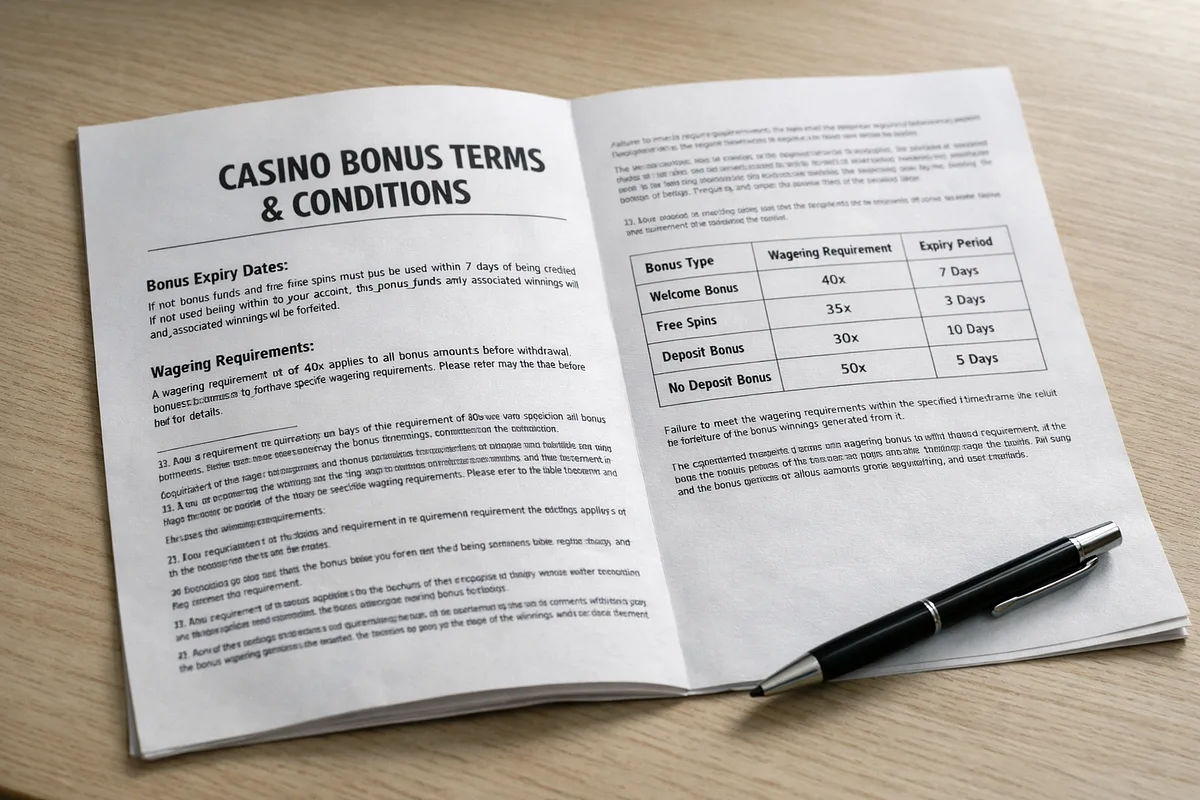
Casino bonus expiry dates are more complicated than they look, because most offers run several independent timers at once rather than one single cutoff. Each timer is triggered by a different action: creating an account, making a deposit, or starting to play. Each one can also expire on a different date. This page explains how those deadlines work, what sets them in motion, and what you lose if any one of them runs out before you meet the conditions attached to the bonus. By the end, you’ll be able to spot which timers apply to a given offer and decide whether and how to use it.
The Three Independent Clocks on a Single Bonus
A single bonus offer commonly carries three separate deadlines, each started by a different event and each capable of ending on a different date. The claim period, the wagering completion window, and (where free spins are included) the free spin expiry all run independently of one another. To read a bonus correctly, you need to identify each clock, the event that starts it, and the date it closes. Treating the whole offer as having one unified expiry date is how people miss deadlines.
The Claim or Activation Period
The claim or activation period is the window in which you have to take action to secure the offer after becoming eligible for it. The clock starts on a fixed event stated in the bonus terms, typically account registration or the offer’s launch date, and it runs whether or not you’ve made a deposit or even opened the promotions page. If the window closes before you act, the offer is gone, and a qualifying deposit made after that point won’t bring it back.
This clock is separate from any wagering deadline, and it can expire without any obvious warning. If you register, leave the account alone, and come back a few days later, the offer may already be dead before you’ve placed a single real-money bet. When reading bonus terms, treat the activation period as its own separate check: find the event that starts it and the date or duration that ends it, and confirm both independently from the wagering terms elsewhere in the same document.
The Wagering Completion Window
The wagering completion window is the period, measured in days from a specific trigger event, in which you have to satisfy the playthrough requirement attached to the bonus. It’s the deadline most often described simply as “bonus expiry,” but that framing hides the fact that it starts from its own trigger. That trigger might be the deposit date, the moment you activate the bonus, or something else named in the terms. It’s not necessarily the same event that started the claim period.
Observed windows range from 24 hours to 30 days. Shorter windows are common on free spin bonuses, where seven days is a typical figure. Longer windows of around 30 days appear more often on deposit match offers with larger wagering requirements. Where the trigger is the deposit date rather than the moment you first play, depositing and then waiting before you start reduces your effective time, even though the stated window hasn’t changed. When reading the terms, check two things separately: how long the window is, and which specific event starts it. The same headline duration can mean very different amounts of usable time depending on the trigger.
The Free Spin Expiry as a Separate Clock
Free spins included in a combined offer carry their own expiry deadline, separate from the primary bonus expiry and often shorter. Any winnings those free spins produce are treated as a distinct part of the promotion: credited separately, subject to their own wagering requirement, and governed by their own expiry window, which can be as short as 24 hours from the point of credit.
If you assume free spin winnings inherit the primary deposit match’s expiry window, you’ll misread how much time you actually have to clear the attached playthrough. When a bonus combines a deposit match with free spins, the terms contain at least two separate expiry structures: one for the matched funds and one for the free spin winnings. You need to read and track each one on its own.
Which Event Starts Each Clock
Each deadline attached to a casino bonus starts running from a specific trigger event named in the terms, not from the moment you notice the offer. Because different clocks start from different events, the gap between when a clock begins and when you first check the terms directly eats into the time you have available. That’s why the trigger event is the piece of information that turns a stated window length into actual remaining time.
The Three Common Trigger Points
The wagering clock starts from one of three trigger points defined in the bonus terms. Knowing which one applies is what lets you calculate how much time you genuinely have, rather than how much the headline figure implies.
When the clock starts at account registration, it runs from the moment the account is created, regardless of whether you’ve deposited or touched the bonus. A stated window that began at registration but went unnoticed for two days is effectively two days shorter than the figure in the terms. When the clock starts at the qualifying deposit, it begins on the date the funds are received, so depositing and then delaying your first play means you’re already burning through the window before you’ve started. When the clock starts at first use of bonus funds, you control when it begins, but only up to the point where the deposit itself expires under a separate deadline.
Some promotions count bonus expiry from the deposit date rather than from the moment you first use the bonus, which shortens the effective window for anyone who doesn’t start playing right after depositing. The phrase “valid for X days” in a bonus term is incomplete until you know which trigger event starts the count.
| Trigger Event | What the Clock Measures From | Effect on Your Effective Window |
|---|---|---|
| Account registration | The moment the player’s account is created | Any delay between registration and first noticing the offer reduces the effective window by the same number of days elapsed |
| Qualifying deposit | The date the deposit is received by the operator | Time spent between depositing and first using the bonus is consumed from the stated window before play begins |
| First use of bonus funds | The moment the player first wagers using the bonus balance | The full stated window remains available at the point of first use, subject to any separate deposit expiry deadline |
When Clocks Do Not Share the Same End Date
The three clocks on a single bonus can end on three different dates because each is anchored to a different trigger and measures a different period. The claim period may close before you’ve started wagering. The wagering window may run well past the point the claim period ended. Where free spins are included, their expiry may fall before either of the other two deadlines. Multi-stage welcome packages make this more complicated still, since each stage may carry its own validity period with no connection to the others. If you read a layered promotion as though it has one expiry date, you’ll miss the earliest-closing clock while still tracking a later one. Each clock’s end date has to be read on its own, and the deadline that matters most at any given moment is whichever one is closest.
Wagering Requirement Structure and Its Interaction with the Expiry Window
Whether you can clear a wagering requirement before its deadline depends on more than the length of the window. The multiplier base sets the raw volume of play required, and game contribution rates determine how much of each wager counts toward that volume. Together, these two factors set the actual daily clearance you need to hit within the window.
Multiplier Base, Bonus-Only Versus Deposit-Plus-Bonus
A wagering requirement is expressed as a multiplier, but that multiplier is applied to a base amount that varies between offers. When the base is the bonus amount alone, the total playthrough is calculated from that figure only. When the base is the combined deposit-plus-bonus amount, the same headline multiplier is applied to a larger starting figure, producing a much higher total playthrough obligation.
If you compare two offers by their multiplier figures alone without checking what each multiplier is applied to, you’re comparing figures that measure different things. The multiplier and its base have to be read together. The headline number means nothing until you know the base.
The table below shows how each base type works and what it means for total playthrough volume.
| Multiplier Base | What the Multiplier Is Applied To | Effect on Total Playthrough Volume |
|---|---|---|
| Bonus-only | The bonus amount credited to the player’s account, excluding the deposit | Produces a lower total playthrough obligation for the same headline multiplier, because the base excludes the deposit amount |
| Deposit-plus-bonus | The sum of the qualifying deposit and the bonus amount credited | Produces a higher total playthrough obligation for the same headline multiplier, because the base includes both the deposit and the bonus |
Game Contribution Rates
Not every wager counts equally toward clearing a requirement. Contribution rates assign a percentage value to each wager depending on the game category. Slots commonly contribute 100% of each wager toward the requirement, while table games like blackjack may contribute as little as 10%.
This means two players facing the same headline requirement can face very different clearing volumes depending on which games they play. A player who sticks to table games has to wager a much larger total amount to satisfy the same requirement as someone playing slots exclusively.
When you’re working out whether a bonus is completable within its expiry window, the number that matters isn’t the headline requirement. It’s the effective volume of wagers you need to place given the games you actually plan to play. A short window combined with low-contribution games compresses your realistic time further than the stated deadline alone suggests.
Daily Clearance Implied by the Combination
The window length, the multiplier, and the multiplier base combine into a single implied daily clearance figure. A 7-day window on a €4,000 wagering requirement means clearing roughly €570 per day. That figure is fixed by the offer’s terms. You don’t control it.
Expressing the requirement as a daily figure turns an abstract multiplier into something you can actually measure against your own playing habits. A player who typically wagers €100 in a session is in a very different position under that daily obligation than one who wagers €600.
A short window paired with a high multiplier applied to a deposit-plus-bonus base pushes the daily obligation higher still, and game contribution rates below 100% raise the required wager volume further. These are fixed properties of the offer’s structure, set entirely by its terms.
Constraints That Apply During the Wagering Period
The expiry clock isn’t the only rule that determines whether a bonus survives to completion. Maximum bet limits and withdrawal caps run alongside the time-based deadline and can override it as the binding constraint, either by voiding the bonus before time runs out or by limiting what you receive after wagering is done.
Maximum Bet Restrictions
A maximum bet restriction is a per-spin or per-hand cap that applies while bonus funds are active. The cap is set by the operator in the bonus terms and stays in force for the entire wagering period. Exceeding it, even once, can result in forfeiture of the bonus balance and any winnings accumulated up to that point, regardless of how much time is left on the wagering clock.
This has a direct consequence for how you can respond to a short expiry window. Raising your bet size to clear the requirement faster isn’t a viable strategy, because the max bet rule places a ceiling on what counts as compliant play. The pace at which you can work through the wagering requirement is capped by that limit, not by your available funds or remaining time.
The max bet restriction isn’t a loose guideline. It’s a condition of bonus validity, and breaching it gives the operator grounds to cancel the bonus at any point during the wagering period. It’s a hard boundary on compliant play, not a recommended stake level.
Withdrawal Caps
A withdrawal cap limits the amount of bonus-derived winnings you can withdraw after wagering is completed. The cap applies to winnings produced by the bonus funds, not to your own deposit balance. The Gambling Commission’s guidance confirms that operators must allow players to withdraw their deposit funds and may not apply a term that restricts this right.
Even when you complete wagering within the expiry window, the winnings you’ve generated may exceed the withdrawable ceiling set in the terms. The portion above that ceiling isn’t paid out. Completing wagering on time is a necessary condition for receiving bonus-derived winnings, but it’s not sufficient on its own.
The withdrawal cap, the expiry clock, and the max bet rule are all separate conditions, and each one has to be satisfied independently. Meeting the time deadline clears one condition. Staying within the bet cap clears another. The withdrawal cap sets the upper limit on what a successful outcome actually pays.
What Happens When a Deadline Is Missed
When a wagering clock runs out before the requirement is met, what you actually lose isn’t determined by the length of the window. It’s determined by the operator’s terms. The specific outcome clause in those terms is where your real financial exposure is defined, and it varies significantly from one operator to another.
Outcomes at Expiry
When wagering isn’t completed by the deadline, operators apply one of two distinct outcomes. Some remove only the bonus balance and any winnings generated from that bonus, leaving your original deposit untouched. Others apply terms where the deposit balance is also affected at the point of expiry.
That distinction separates two very different risk profiles. Where only the bonus and its associated winnings are removed, your exposure is limited to the opportunity cost of the offer: the potential winnings you didn’t realise. Where the deposit balance is also affected, you face a direct reduction in funds you deposited yourself. The Gambling Commission’s guidance states that operators must allow players to withdraw funds from their deposit balance and that no term may restrict this right, which sets a regulatory boundary relevant to the second category of outcome.
The expiry outcome clause, the term that specifies what gets removed when the clock runs out, is the most consequential line in any bonus terms for assessing real financial risk. Reading the wagering multiplier or the window length without first finding this clause leaves you without the information you need to judge whether a short expiry creates only an opportunity cost or a consequence that affects your deposit.
| Outcome Category | What Is Removed at Expiry | What the Reader Retains |
|---|---|---|
| Bonus balance and associated winnings only | The remaining bonus funds and any winnings produced by wagering those bonus funds are cancelled | The original deposit balance in full, available for withdrawal or continued play |
| Bonus balance, associated winnings, and effect on the deposit balance | The bonus funds and associated winnings are cancelled, and the terms additionally specify a consequence that affects the real-money deposit balance | Whatever portion of the deposit balance, if any, the operator’s terms permit to be retained or withdrawn after the expiry condition is applied |
Reading a Bonus’s Terms With the Clocks in View
A bonus offer isn’t a single proposition with a single deadline. It’s a set of interlocking conditions, each governed by its own clock and its own trigger. Once you can identify which clock is running, what started it, and what lapses when it expires, you’re reading the offer as it actually works rather than as its headline implies.
We check operator terms, licences and payment details against the casino's own pages and update this content when they change. Read our editorial policy, our transparency statement, or report an error. If gambling stops being fun, see our responsible gambling resources.