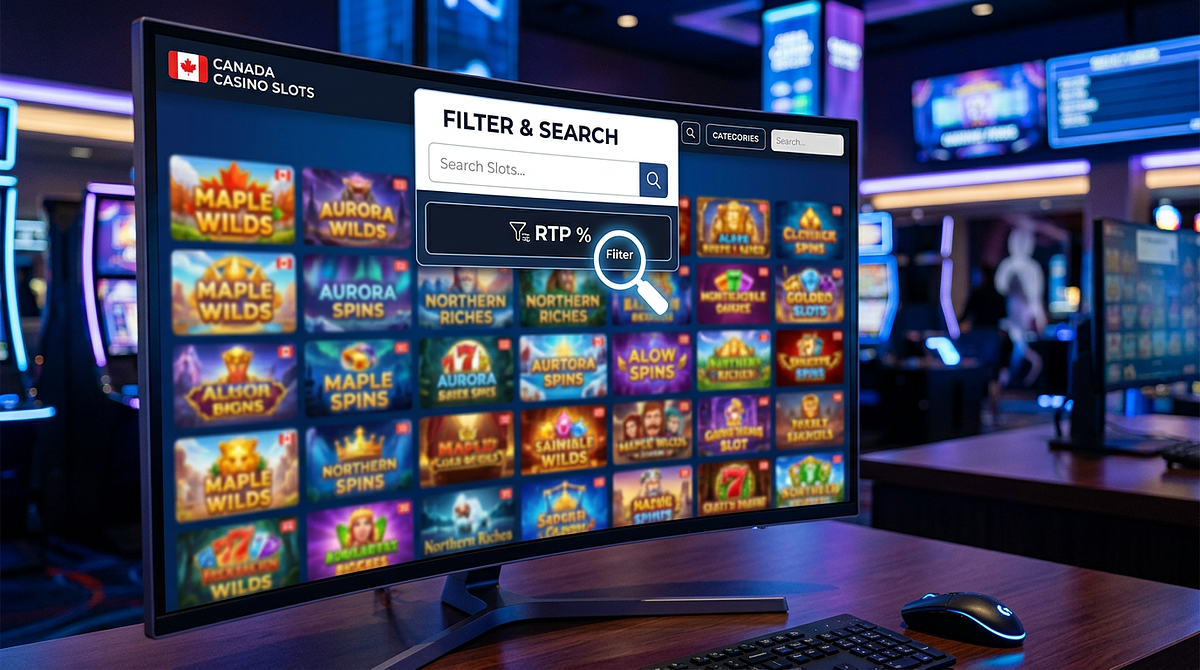
This page covers VegaZone Casino Canada’s slot game library and RTP filter availability in practical terms. We’ll cover how big the catalogue is, which providers are in the mix, what filtering tools the lobby offers, and how the platform’s reported 96.84% average return rate compares to what Canadian players typically find elsewhere. By the end, you’ll have a clear picture of whether VegaZone’s game discovery tools are up to the standard you’d expect from a Canadian online casino.
Game Library Scale and Composition at the Operator
Canadian players generally look at two things when sizing up an online casino: how big the game library is, and how easy it is to find what you’re looking for. Library size breaks down into two separate numbers: total slot count and total live dealer count. Each reflects a different set of supplier relationships and a different type of player demand. A bigger library means the operator has pulled together catalogues from multiple studios and offers more variety across both RNG and streamed formats. But size alone tells you nothing about how easy the library is to navigate.
Slot Count and Live Dealer Count Breakdown
Slot titles are RNG-driven games made by third-party software studios, where outcomes are determined by certified random number generators with no human involvement. Live dealer titles are streamed tables hosted by real dealers in studio environments, sourced from a separate category of supplier. A high slot count means the operator has deals with RNG studios. A strong live dealer count means they have contracts with live streaming providers. Both numbers matter when you’re trying to understand how broad the operator’s supplier relationships are.
| Data Point | Figure |
|---|---|
| Total game library size | 5,000+ |
| Slot titles | 4,000+ |
| Live dealer titles | 380+ |
| Reported average win rate (RTP) | 96.84% |
| Software provider count | Not disclosed on official site; third-party sources cite 73+ additional studios beyond named providers |
| Operating entity | GBL Solutions N.V. |
How Library Scale Shapes the Reader’s Interpretation of a Platform
A four-figure slot count puts VegaZone in the upper tier of Canadian platforms by raw volume. But size is just one input into how discoverable a library is. A catalogue of 4,000+ slots means many supplier catalogues have been pulled into one lobby, giving you variety across volatility profiles, feature sets, and themes. What it doesn’t give you is any built-in order. When a player hits that lobby for the first time, the size of the library doesn’t tell them how quickly they can find titles that match what they’re looking for. That depends on the platform’s filtering tools, not its headcount.
Software Provider Presence and Absence
The studios supplying a casino’s games shape the character of its library more directly than the raw title count does. A library of 4,000+ slots built mostly from independent and mid-tier suppliers will feel different from one built primarily around dominant industry names. The presence of certain studios signals specific volatility profiles and feature mechanics. The absence of dominant studios means certain widely recognised titles and mechanical styles aren’t available on the platform.
Providers Present in the Library
VegaZone’s library draws from a broad range of studios, with the mix leaning toward independent and mid-tier suppliers alongside some larger names. The official site names a subset of providers, and third-party review sources identify additional studios as present. The following studios are confirmed across those sources:
- Pragmatic Play – high-volume studio known for high-volatility slots with bonus-buy mechanics, cited in third-party review sources as present despite being listed as absent in the casino.org review prose; the official site listing takes precedence here as the primary source
- Play’n GO – studio known for narrative-driven slots with a wide volatility range, including widely recognised titles such as Book of Dead
- Wazdan – independent studio known for slots with adjustable volatility settings
- BGaming – independent studio known for crypto-oriented slots and provably fair mechanics
- Microgaming – major studio known for progressive jackpot networks and a broad back-catalogue
- Novomatic – European studio known for classic reel-style slots and land-based-derived titles
- Evolution – dominant live dealer supplier known for streamed table games and game show formats
- Hacksaw Gaming – independent studio known for high-volatility slots and scratch card mechanics
- Relax Gaming – independent studio known for high-volatility slots and its aggregation platform
- 4ThePlayer – independent studio known for mathematically complex slots with unconventional reel structures
- Fantasma Games – independent studio known for feature-dense slots with distinctive visual design
Notable Provider Absences
When a major studio is missing from a casino’s library, that’s a concrete signal about which titles and mechanics a player won’t find there. Third-party review sources identify Red Tiger and NetEnt as absent from VegaZone’s library. Red Tiger is known for daily jackpot mechanics and a catalogue of high-volatility titles widely available across Canadian platforms. NetEnt has a large back-catalogue of well-known slots with strong player familiarity in the Canadian market. If your preferred titles come from either studio, you won’t find them at VegaZone, regardless of how large the overall library is.
Filtering and Game Discovery Infrastructure
Filtering tools are what make a large game catalogue usable. A library of 4,000+ slots with no functional sorting is, from a practical standpoint, less useful than a smaller library with solid filtering, because a player who can’t locate titles that match their criteria is effectively cut off from most of what the platform holds. Library size and filtering capability are two separate things, and the gap between them is where discoverability is won or lost.
Standard Filter Types Across Canadian Online Casinos
Game filters are sorting tools applied to a casino lobby. They narrow the displayed titles by matching player-selected attributes against tagged game data. Canadian platforms, including those in Ontario and Alberta’s regulated markets, tend to offer a common set of filter types, though RTP-based sorting is generally not part of that standard set. The filter categories that appear consistently across Canadian platforms are:
- Provider – narrows the lobby to titles supplied by a specific software studio
- Feature – filters by mechanical attributes such as free spins, bonus rounds, or multipliers
- Theme – narrows by visual or narrative category, such as mythology, adventure, or classic fruit
- Volatility – filters by the frequency and size distribution of payouts, from low to high
- Jackpots – isolates titles with fixed or progressive jackpot prize structures
- Game type – separates categories such as slots, table games, and live dealer titles
RTP-Based Filtering and Why It Is Typically Absent
RTP-based filtering is a lobby tool that sorts or narrows the displayed games by each title’s theoretical return-to-player percentage. Canadian regulated platforms, including those in Ontario and Alberta, generally don’t surface RTP as a sortable lobby dimension. That’s a market-wide convention, not a decision specific to any one operator. Some platforms outside that convention offer a separate live RTP lookup database as an alternative, with Bitcasino, Livecasino.io, and Sportsbet.io cited as examples. If you know that RTP filtering is a market-wide gap, you’ll read its absence at any given operator more accurately, and you’ll recognise a live RTP database as the exception rather than the norm.
Filtering Shortcomings at the Operator Under Review
Third-party review sources describe VegaZone’s games lobby as hard to filter, which is a real problem given the library’s size. The live dealer menu isn’t divided into categories, so a player looking for a specific live title has to use the search bar or browse by provider rather than navigating through organised sections. Knowing what a platform is missing in filtering tools, not just what it offers, gives you a more accurate sense of how discoverable a 4,000+ slot library will be. The description here reflects what the available review sources document and doesn’t go beyond what those sources support.
Reported Average Return-to-Player Figure and Its Interpretive Weight
Many operators publish a single aggregate win rate figure that represents the theoretical return across their entire game library. That figure is one input among several for evaluating a platform. It doesn’t describe how any individual title performs, and it doesn’t account for the spread of titles that produce the average. Understanding what the figure measures, and what it can’t tell you, is more useful than the number itself.
The Aggregate RTP Figure in Context
VegaZone’s reported average win rate is 96.84%, a figure that appears in a third-party casino comparison table rather than in any official publication from the operator itself. As a weighted average across the full game library, it doesn’t describe the RTP of any individual slot title within that catalogue. The Canadian market benchmark for slots classified as high RTP sits at 96% or above, which puts VegaZone’s aggregate figure just above that threshold. Top-performing individual titles in the Canadian market reach 97% to 99%. The fact that the aggregate sits above the benchmark tells you something about the overall composition of the library, but it doesn’t identify which titles within the 4,000+ slot catalogue are driving that average. That distinction matters when you’re picking specific games rather than evaluating the library as a whole.
Reading a Canadian Casino Lobby’s Library and Filter Set as Separate Signals
VegaZone’s 96.84% aggregate RTP sits above the Canadian market’s 96% benchmark for high-RTP slots, but that figure is a library-composition signal. It tells you something about the overall mix of titles, not how any individual game within the 4,000+ catalogue will perform for you. That distinction matters more than the number itself, especially when the lobby’s filtering tools make it harder to locate specific titles in the first place. The absence of RTP-based sorting isn’t a VegaZone-specific gap; it’s a market-wide norm across Canadian regulated platforms. That means the real differentiator between operators is how well their other filters, such as provider, volatility, and feature type, make up for it. At VegaZone, third-party sources flag the lobby as hard to filter and the live dealer menu as undivided, which creates real friction against a catalogue of this size. If you want to see how that filtering experience compares to platforms that handle discovery differently, our Canadian casino comparison tool is a practical place to start. See how VegaZone compares to Bulletz for crypto deposits in Canada, and the full VegaZone Casino review.