


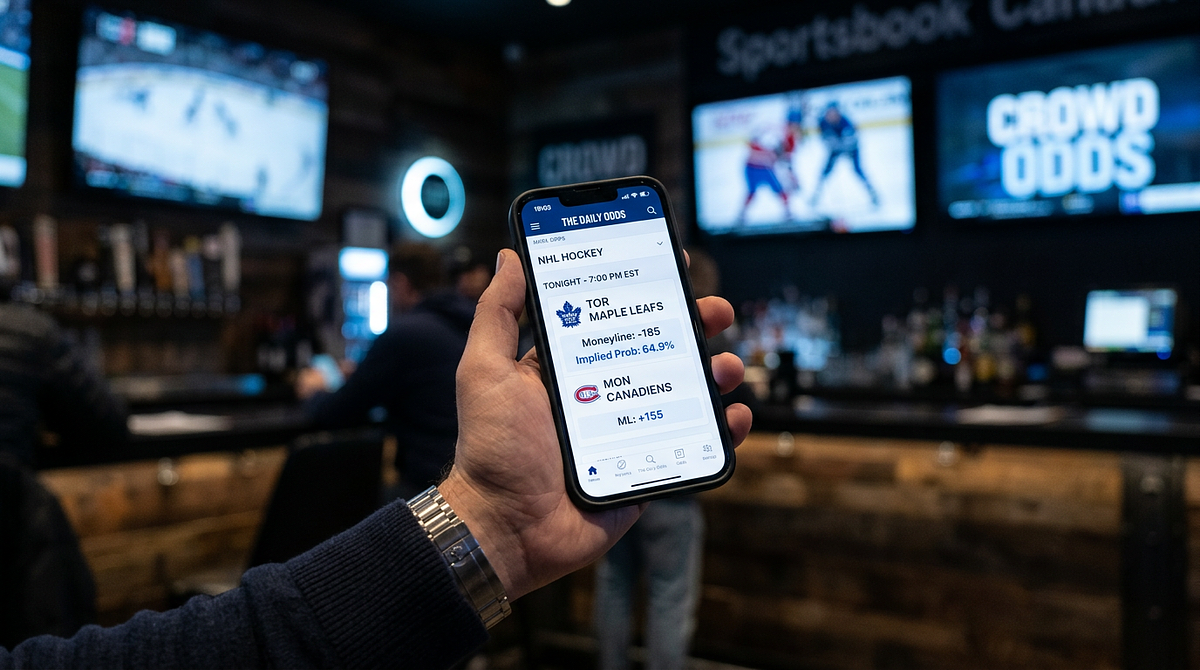
Not all Maple Leafs odds are created equal. The same game can carry meaningfully different prices depending on which licensed Ontario platform you check, so understanding how these numbers work matters. This page covers how moneylines, puck lines, totals, and futures are priced on Toronto, why lines move as puck drop approaches, and what drives the differences between books. By the end, you’ll have a solid basis for comparing odds and deciding where to place your bets.
The Canadian Regulated Betting Landscape for NHL Wagering
Legal online sports betting in Canada is regulated province by province, so there’s no single national framework governing which operators you can access. One province has built a fully regulated online market with a wide roster of licensed private operators, and the minimum age to wager through those operators is 19. Other provinces work differently.
The Provincial Licensing Framework
Ontario launched its regulated online igaming market on April 4, 2022, making it the province with the most developed licensed-operator ecosystem in Canada. The regulator overseeing this market is the Alcohol and Gaming Commission of Ontario (AGCO), which registers operators and sets conduct standards. iGaming Ontario, a subsidiary of the AGCO, conducts and manages the market on behalf of the province.
A licence issued within Ontario’s framework only authorises an operator to accept wagers from bettors physically located in Ontario. It doesn’t extend to other provinces or territories. So when a bettor in British Columbia or Alberta visits the same operator’s website or app, that operator isn’t functioning under an Ontario-issued licence for that transaction. An operator’s national branding or advertising doesn’t determine its legal status in a given province. Your province of residence does.
Eligibility and Legal Access
Ontario-licensed operators are required to verify that bettors are 19 or older and physically located within the province at the time of wagering. Age and residency verification are operator obligations under the AGCO framework, not optional practices. Bettors in other provinces access sports wagering through different channels: either a provincial monopoly platform run by that province’s lottery corporation, or unregulated offshore sites that operate outside any Canadian licensing regime. These three routes (Ontario-licensed private operators, provincial monopoly platforms, and offshore sites) are legally and structurally distinct. The consumer protections, dispute mechanisms, and regulatory oversight attached to each one are different.
Licensed Sportsbook Options Available to Canadian Bettors
Within Ontario’s regulated market, multiple licensed operators post odds on the same Maple Leafs games at the same time. Because each operator runs its own book and responds differently to regional wagering volume, the number posted on one platform isn’t a market consensus. It’s one operator’s position. Checking several licensed platforms rather than defaulting to a single book is the practical takeaway from this structure.
The Licensed Operator Landscape
The licensed operator category in Ontario includes internationally recognised sportsbook brands: bet365, BetMGM, BetRivers, Caesars Sportsbook, and DraftKings, alongside Canadian-focused platforms such as Sports Interaction. Sports Interaction, owned by ElectraWorks Maple Limited and originally established in 1997, is a regulated sportsbook in Ontario. Available research does not confirm whether it holds authorisation in any other Canadian province, which matters when interpreting any national-scope marketing it may run. Affiliate rankings have cited Sports Interaction favourably for team-specific live odds coverage on NHL franchises including the Leafs, but those ratings reflect an editorial assessment by the publishing affiliate, not a regulatory endorsement or independently audited performance standard.
| Operator | Regulatory Scope in Canada | Notable Coverage Feature | Source Type |
|---|---|---|---|
| bet365 | Licensed in Ontario only | Stanley Cup futures posted continuously; line of +500000 recorded July 12, 2026 | Regulated |
| BetMGM | Licensed in Ontario | Stanley Cup and Eastern Conference futures available throughout the season | Regulated |
| Caesars Sportsbook | Licensed in Ontario | Over 100 in-game wagering options per Leafs game | Regulated |
| Sports Interaction | Canadian-focused; regulated in Ontario | Rated 4.9/5 for live team odds by affiliate coverage | Affiliate assessment |
Reading Odds in American Format
Canadian sportsbooks display NHL odds, including every Maple Leafs market, in American format, also called moneyline format. Every bet type covered in this article, from game-level moneylines to Stanley Cup futures, uses this convention. If you can’t read American odds, you can’t accurately assess what any posted number means in terms of payout or implied probability.
Favourite and Underdog Designations
A minus sign in front of a number identifies the favourite and tells you how much you need to stake to return a profit of C$100. A plus sign identifies the underdog and tells you the profit returned on a C$100 stake.
Here’s a straightforward example: if the Maple Leafs are priced at -140, you need to stake C$140 to profit C$100, receiving C$240 back in total. If the opposing team is priced at +120, a C$100 stake returns a C$120 profit, for a total payout of C$220.
The sign doesn’t express a qualitative judgment about either team. It translates the market’s estimate of relative winning probability into a payout structure. A minus price means the market assigns that team a greater-than-50% chance of winning. A plus price means the opposite. The size of the number in each direction reflects how wide the market thinks the gap in likelihood is.
Deriving Implied Probability from a Posted Line
American odds convert to implied probability through two formulas, one for each sign direction. For positive odds: 100 divided by (odds + 100). For negative odds: the absolute value of the odds divided by (the absolute value of the odds + 100).
The bet365 Stanley Cup line of +500000 posted as of July 12, 2026 shows how this works at an extreme: 100 divided by (500000 + 100) equals approximately 1.32%. That number isn’t primarily a statement about payout size. It’s the market expressing near-total scepticism about the Leafs winning the championship at that point.
Implied probability gives you a common scale across all market types. A moneyline, a puck line, and a futures price are otherwise expressed in incomparable units. Converting each to an implied probability lets you evaluate what the market is saying about likelihood across all three at once.
Game-Level Bet Types for Maple Leafs Contests
Every Maple Leafs game on a licensed Canadian sportsbook generates three independently priced markets: the moneyline, the puck line, and the over/under total. Each market asks a different question about the same contest, and each carries its own odds. Reading a Leafs game page accurately means understanding what each market is measuring and how its pricing works.
The Moneyline Market
The moneyline is a straight wager on which team wins the game outright. No goal margin applies. The only condition is that your selected team wins in regulation, overtime, or a shootout. The favourite carries a minus price, and the underdog carries a plus price, with the size of each number reflecting the market’s read on relative team strength on that specific date.
Roster availability is a direct input into moneyline pricing. When a high-impact player is out, the market adjusts the line to reflect the reduced win probability for that team. Auston Matthews was listed as out for the 2025-26 season with a knee injury, per Action Network’s NHL injury report. If a moneyline looks more generous than expected on a Leafs game, it’s more likely reflecting an absence like this than a pricing error by the operator.
Line movement in the hours before puck drop carries information beyond the current price. When a line shifts materially from its opening number, that movement shows where wagering volume is concentrated and which side the market is absorbing more money on, rather than simply reflecting a change in the operator’s initial assessment.
The Puck Line
The puck line is the NHL’s standard goal-margin market, and the spread is fixed at 1.5 goals across the sport. Unlike point spreads in other leagues, this number doesn’t move. All the pricing adjustment between a strong favourite and a weaker opponent happens through the odds attached to each side, not through changes to the margin itself.
The favourite must win by two or more goals to cover the minus-1.5 line. The underdog covers by winning outright or by losing by exactly one goal. As an example: if the Leafs are the favourite at -1.5 with odds of -200, a C$100 stake returns C$50 in profit. If the opposing team is the underdog at +1.5 with odds of +165, a C$100 stake returns C$165 in profit.
Because the spread is fixed, a material shift in the puck line price between opening and puck drop isn’t a mechanical adjustment to the margin. It’s the market revising its read on the matchup. A Leafs puck line that opens at one price and closes at a meaningfully different one signals that new information, such as a late injury report or concentrated wagering on one side, has changed how the book is positioned.
Over/Under Totals
A totals wager is a bet on whether the combined goals scored by both teams will finish above or below a number posted by the sportsbook. NHL totals commonly fall in the 5-7 goal range, and the odds on each side of that line can vary substantially between licensed operators posting the same game.
The posted total encodes each book’s implicit forecast about the pace of play and the offensive and defensive profiles of both teams on that date. A Leafs game posted at the lower end of the 5-7 range expresses a different underlying expectation about scoring conditions than one posted at the upper end. The number isn’t arbitrary. Comparing the same game’s total across two licensed Ontario operators reveals how each book has weighted those inputs, since identical games can carry different posted numbers and different odds on the same side.
Futures Markets on the Maple Leafs
Futures markets price outcomes that settle at the end of a full season rather than after a single game. When you place a futures wager on the Leafs, you’re not predicting the result of Tuesday’s contest. You’re taking a position on a season-long outcome. Three distinct tiers of futures apply to this franchise: the Stanley Cup, the Eastern Conference, and the Atlantic Division.
Stanley Cup, Conference, and Division Futures
The three tiers reflect progressively narrower competitive fields. Division futures price the shortest path: finishing first among a small cluster of Atlantic Division teams. Conference futures price a mid-length path, requiring the Leafs to advance through the Eastern Conference bracket and reach the Stanley Cup Final. Stanley Cup futures price the full path: winning the championship outright against the entire league field.
Lines across different licensed operators on the same futures tier can diverge sharply, and that gap widens when a team’s competitive standing shifts mid-season. The table below records posted odds from identified operators alongside the implied probability derived using the formula established earlier in this article: 100 divided by (odds + 100) for positive lines.
| Market Tier | Operator | Posted Odds | Implied Probability |
|---|---|---|---|
| Stanley Cup | bet365 (as of July 12, 2026) | +500000 | 1.32% |
| Stanley Cup | BetMGM (during 2025-26 season) | +3000 | 3.23% |
| Stanley Cup | Fox Sports (during 2025-26 season) | +3300 | 2.94% |
| Eastern Conference | BetMGM (during 2025-26 season) | +1700 | 5.56% |
| Eastern Conference | Fox Sports (during 2025-26 season) | +1700 | 5.56% |
| Atlantic Division | Fox Sports (during 2025-26 season) | +950 | 9.52% |
Interpreting Futures Movement Across a Season
Futures prices move in response to on-ice results, injuries, and standings position throughout the season. A line posted in October encodes a different set of inputs than one posted in March, and reading either number without anchoring it to a specific point in the season strips it of any real meaning.
The Leafs finished the 2025-26 regular season 32-36-14, placing 8th in the Atlantic Division and missing the playoffs entirely. The OLG publicly anticipated a drop-off in overall betting volume following that elimination, a signal that the franchise’s wagering market contracts materially when the team is no longer in contention. A Stanley Cup futures price posted deep into the summer following a non-playoff finish, such as the +500000 line recorded in July 2026, encodes near-total market scepticism about the franchise’s championship prospects at that moment. A mid-season price posted during a competitive stretch, when the team held a realistic path to the playoffs, encodes a different market posture. Understanding this distinction means treating a futures line not as a fixed forecast but as a snapshot of market sentiment at a specific point in the season’s arc.
Player Props and Parlays
Beyond the three game-level markets covered above, licensed Canadian sportsbooks post two additional market categories on Maple Leafs games: player props, which are wagers on individual-performance outcomes within a single contest, and parlays, which combine multiple selections into one wager with multiplied odds. Both categories are prominent in Leafs coverage across Ontario-licensed operators. Team markets only cover part of a game card. Individual player prop bets operate under a different set of rules worth knowing separately.
Player Prop Markets
A player prop is a wager on whether a specific player will exceed or fall short of a statistical threshold within a single game: goals scored, shots on goal, assists, points, and similar individual-performance measures. The wager resolves on that player’s output in that game alone, regardless of which team wins or what the final score is.
The range and depth of prop coverage varies materially between licensed operators. Caesars Sportsbook, for instance, offers more than 100 wagering options per Leafs game through its live betting suite, per pre-research data. Not every Ontario-licensed operator matches that depth, and the gap between a book with extensive prop coverage and one with minimal coverage isn’t cosmetic. It reflects how actively that operator is pricing the specific matchup. When comparing two licensed platforms on the same Leafs game, prop depth works as a proxy for the granularity of each operator’s team-specific pricing investment.
Parlay Construction
A parlay is a single wager that combines two or more individual selections. Every selection in the parlay must win for the wager to pay out. One losing leg voids the entire ticket. The odds across all legs multiply together, producing a combined payout substantially larger than any single-leg price.
Here’s an example: two selections priced at +150 and +130 respectively combine into a parlay. Converting each to a decimal equivalent (2.50 and 2.30) and multiplying gives 5.75, which translates to approximately +475 in American format. A C$100 stake on that parlay returns approximately C$475 in profit if both legs win.
The multiplicative payout isn’t a promotional feature. It’s a direct mathematical consequence of the multiplicative decline in implied probability across the combined legs. Each leg’s implied probability reduces the overall likelihood of the parlay winning, and the multiplied odds reflect that compounding reduction. A parlay’s advertised return is a function of the individual legs’ implied probabilities, not a bonus structure layered on top of them.
Odds Shopping Across Canadian Sportsbooks
Two licensed Ontario operators posting odds on the same Leafs game are not publishing the same number. They’re each publishing their own position. The gap between those positions isn’t random noise. It follows a recognisable pattern across both game-level markets and futures, and identifying that pattern is the practical application of everything explained in this article.
How and When Lines Diverge
Opening lines on Leafs games are generally consistent across Canadian and Las Vegas sportsbooks. Divergence emerges in the hours before puck drop, as local books absorb regional wagering volume and adjust their positions in response to where Ontario bettors are concentrating their money. A line that opened at one price across multiple operators can close at materially different prices on each, because each book is managing its own exposure rather than tracking a shared consensus.
Futures markets show a different divergence pattern: prices across operators can differ substantially at the same point in time, not just as a game approaches. The Leafs’ Stanley Cup futures line ranged from +3000 at one operator to +3300 at another during the 2025-26 season, while a third operator posted +500000 in July 2026, a figure reflecting the team’s non-playoff finish rather than a mid-season competitive assessment. The Eastern Conference line, by contrast, sat at an identical +1700 across two operators simultaneously, showing that convergence and divergence can coexist across tiers of the same futures market at the same time.
A bettor reading several licensed operators simultaneously isn’t looking for a single correct number. No such number exists. They’re mapping the range of market opinion, identifying which books are pricing the Leafs more optimistically or pessimistically at that moment, and using the implied probability formula to express those positions on a common scale.
Reading Leafs Odds Across Canadian Sportsbooks with Confidence
Every posted number on a Leafs market is a probability statement, and that probability varies across licensed Ontario operators because each book manages its own position independently. A bettor who treats any single operator’s line as the definitive market price is reading one book’s opinion, not the market’s consensus. Converting any posted odds to an implied probability, and comparing that figure across two or more licensed Canadian platforms, is the practical skill that makes the difference between reading a number and understanding what it means.
We check operator terms, licences and payment details against the casino's own pages and update this content when they change. Read our editorial policy, our transparency statement, or report an error. If gambling stops being fun, see our responsible gambling resources.