
This breakdown covers the RTP values, volatility ratings, grid structures, and bonus mechanics for Stick’em and Chaos Crew. It’s organised around four areas: operator-adjustable RTP tiers, grid and payline structure, bonus mechanics, and maximum win potential. By the end, you’ll have enough detail to compare the two games technically and decide which one fits what you’re looking for.
Developer Slot Portfolio Context and RTP Range Framework
Hacksaw Gaming releases its titles with operator-adjustable RTP tiers rather than a single fixed return figure. Almost every game in the studio’s catalogue comes with a default tier plus one or more lower variants, and the official game pages list these variants openly. This means the RTP you actually play at depends on which tier the casino you’re using has switched on. The figures in the tables below show the developer’s published range, not a guaranteed rate at every casino.
Sticky Symbol Slot Specification and Mechanics
Stick’em is Hacksaw Gaming’s debut slot from 2019, built around a character called Canny the Can and a sticky-symbol respin structure. Two numbers define where this game sits: a published RTP of 96.1% and a maximum win of 100,000x your bet. Both figures put Stick’em in a different bracket than the Chaos Crew series, which runs higher volatility but lower maximum win multiples. That combination of RTP and win cap sets the mathematical boundaries for how the sticky mechanic plays out.
Core Specification Table
The table below pulls together the confirmed specs for Stick’em.
| Specification | Value |
|---|---|
| RTP (default) | 96.1% |
| Volatility | Medium |
| Grid layout | 5×4 |
| Paylines / ways | 1,024 ways to win |
| Maximum win | 100,000x bet |
| Release date | 2019 |
Sticky Symbol Mechanic and Bonus Structure
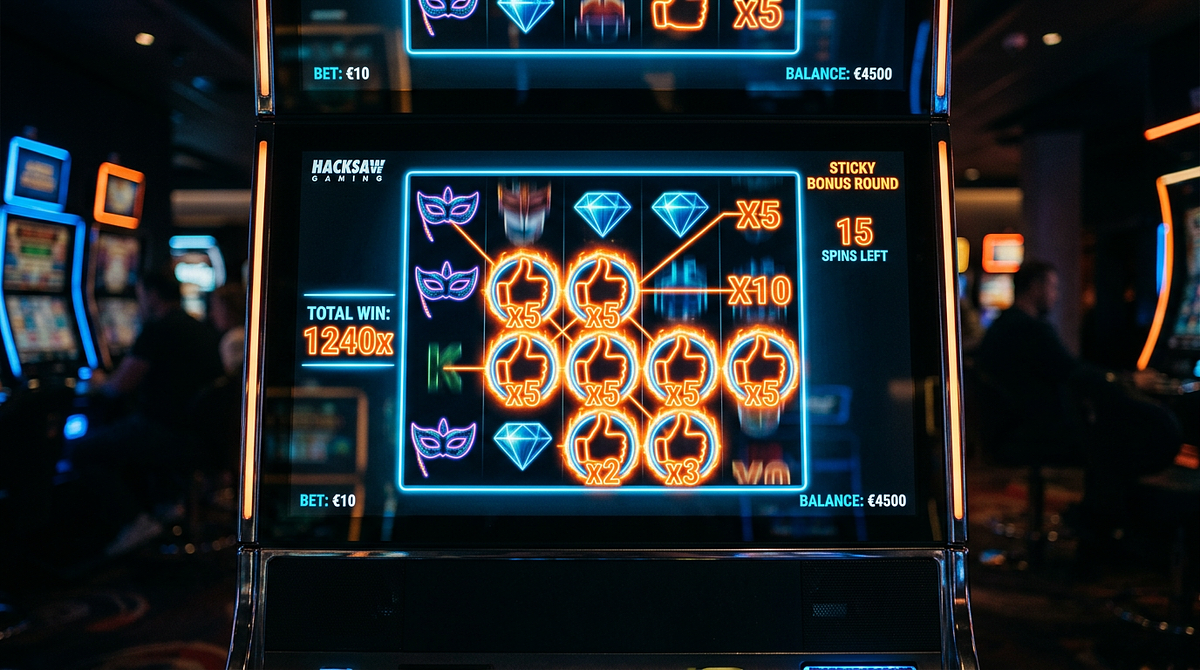
The main mechanic in Stick’em is the Sticky Win Spin. If you land three thumbs-up symbols in a winning combination during the base game, you get a respin where those thumbs-up symbols lock in place. The respin keeps going as long as at least one new thumbs-up lands each spin, building locked symbols across the 5×4 grid. When a spin produces no new thumbs-up, the feature ends.
There are two other bonus paths alongside the sticky mechanic. Landing three or more scatter symbols awards free spins on a sliding scale: 3, 4, or 5 scatters give you 5, 10, or 15 spins, with extra high-value symbols added to the reels during the feature. Three bonus symbols trigger a three-tier Bonus Wheel with progressive inner rings.
The 100,000x maximum win is reachable through extended sticky accumulation combined with the compounding effect of stacking features across the 1,024-ways pay structure. The medium volatility rating reflects that the sticky feature triggers fairly often at low accumulation depths, while the outcomes needed to get near the ceiling are statistically rare.
Multi-Title Franchise Specification Overview
The Chaos Crew franchise from Hacksaw Gaming includes three sequential releases published between 2020 and 2025: the original Chaos Crew, Chaos Crew 2, and Chaos Crew 3. All three share a volatility rating of 5/5, putting the franchise at the high end of variance across the developer’s catalogue. Each new entry raises the maximum win ceiling and changes either the payline structure or the grid mechanics, so the sequels aren’t just reskins. They’re reconfigurations of the underlying math model.
Volatility stays constant across all three, while the payout ceiling and structural complexity go up with each release. Default RTP figures sit within a narrow band across the franchise.
Cross-Title Specification Comparison
The table below shows the direct specification comparison across all three Chaos Crew titles, based on developer publications and third-party review sources.
| Specification | Chaos Crew (Original) | Chaos Crew 2 | Chaos Crew 3 |
|---|---|---|---|
| Release date | September 24, 2020 | September 2023 | June 25, 2025 |
| Grid layout | 5×5 | 5×5 | 5-reel |
| Paylines | 15 fixed | 19 fixed | 19 fixed + cluster pays (5+ adjacent) |
| Default RTP | 96.30% | 96.27% | 96.18% |
| RTP variants | 92.40%, 88.40% | 94.22%, 92.41%, 88.28% | Not published by developer at time of writing |
| Volatility | 5/5 | 5/5 | 5/5 |
| Maximum win | 10,000x | 20,000x | 30,000x |
| Bet range | Not disclosed on official game page | €0.10 – €100 | €0.10 – €30 |
| Bonus Buy | 129x stake (RTP 95.92%) | Available; multiple buy options, cost not disclosed | Available; cost not disclosed |
RTP Tier Interpretation and Operator Adjustment
Hacksaw Gaming publishes multiple RTP tiers for each title in the franchise, and the casino chooses which tier to activate when it deploys the game. That means two players wagering on the same Chaos Crew title at two different casinos could be playing at materially different theoretical return rates, even though the game looks and plays identically. The variant range in the table above shows every tier the developer makes available to licensees, not the return any specific player will see in a session.
To find out which tier is active at your casino, check the in-game information panel, usually accessed through the menu or settings icon inside the game. The paytable disclosure rules require the active RTP to be shown there, and that figure takes priority over any default cited on external review sites. If you’re comparing casinos for the same title, the info-panel figure is the one to trust. Players in regulated markets such as Ontario online casinos benefit from stricter disclosure requirements that make it easier to verify which RTP tier is active before you play.
Bonus Round Architecture Across the Franchise
Every Chaos Crew title is built on the same bonus template: a free-spins round that works as a hold-and-win feature, paired with a wild multiplier that goes higher during the feature than in the base game. The sequels don’t scrap this template. They add more evaluation rules on top of it. Chaos Crew 2 introduces a “best-of” mechanic that changes how a single bonus entry is scored. Chaos Crew 3 adds a cluster pays system on top of the same underlying free-spins structure.
Free Spins Trigger and Hold-and-Win Structure
The bonus round starts when you land three scatter symbols during base play, confirmed on the Chaos Crew 2 official game page and consistent across the franchise. You enter the feature with three respins. Each new special symbol that lands, including reel multipliers and the Cranky the Cat wild multiplier, locks in place and resets the respin counter back to three. When a spin produces no new qualifying symbol, one respin is used up. The feature ends when the counter hits zero or all reel positions are filled.
The Cranky the Cat wild carries a 2x–5x multiplier in the base game and goes up to 20x during free spins, with multiple wilds multiplying each other’s values. That escalation is what makes the maximum win ceiling reachable. At base-game multiplier levels alone, the 20,000x or 30,000x caps published for the sequels are mathematically out of reach. You need the compounded 20x wild values combined with reel multipliers to produce outcomes near the ceiling.
Sequel Bonus Feature Modifications
Chaos Crew 2 modifies the base structure through a “Best of Bonus” mechanic. A single bonus entry runs three full turns of the free-spins round, and the payout is calculated from the highest of the three results, multiplied by the selected wager level. The reported 27% win rate for Chaos Crew 2 reflects the higher proportion of spins that resolve into a paying outcome under this rule, which raises the effective payout expectation per bonus entry compared to the original title’s single-run structure. Chaos Crew 3 keeps the three-lives hold-and-win base and adds a cluster pays overlay requiring five or more adjacent symbols. This changes how individual bonus outcomes are counted and shifts the distribution of bonus payouts toward denser symbol formations rather than fixed payline hits.
Bonus Buy Feature Economics
All three Chaos Crew titles include a Bonus Buy option, as long as the casino’s jurisdiction allows it. This lets you pay a fixed multiple of your current stake to trigger the free spins round directly, skipping the wait for a natural scatter combination. Because the purchase price is set independently of the expected value of the triggered feature, using a Bonus Buy shifts the effective RTP of your session away from the figure that applies to organically triggered play.
Cost, Trigger Guarantee, and RTP Impact
In the original Chaos Crew, the Bonus Buy costs 129x your current stake. Paying that amount guarantees three scatter symbols on the next spin, which triggers the free spins feature directly rather than through random scatter accumulation in the base game. At the default RTP tier, using the Bonus Buy gives you an effective RTP of 95.92%, compared to the 96.30% that applies to organic triggering at the same tier.
That 0.38 percentage point difference means the 129x purchase price isn’t perfectly aligned with the mathematical expectation of the free spins feature it unlocks. The purchase costs slightly more than the feature returns on average, so waiting for a natural trigger gives you a marginally better theoretical return. The Bonus Buy trades a small amount of expected value for immediate access to the bonus round. Comparable Bonus Buy pricing and RTP delta figures for Chaos Crew 2 and Chaos Crew 3 aren’t publicly documented in the developer’s disclosures. It is also worth noting that Bonus Buy availability varies by jurisdiction — for example, players accessing these titles through British Columbia online casino sites may find that local platform rules affect which purchase options are offered.
Demo Play Availability and Verification Sources
Free demo versions of these titles are available through Hacksaw Gaming’s official catalogue at hacksawgaming.com/games and through third-party slot databases like spindex.net, which hosts a Stick’em demo among others. Demo mode lets you watch how the grid behaves, how often scatters trigger, and how multipliers distribute during bonus rounds, all without wagering real money. Demo builds typically run at the developer’s default RTP tier: 96.10% for Stick’em, 96.30% for Chaos Crew, 96.27% for Chaos Crew 2, and 96.18% for Chaos Crew 3. They don’t reflect the lower tiers, down to 88.28%, that a live casino may have activated.
The mechanics are identical between demo and real-money play. The only variable is the active RTP tier, not the game logic, so hit frequency patterns you observe in demo carry over to real play, but long-run return does not. If you want to play these titles for real money, reviewing the options available through Alberta online casino sites can help you identify which operators carry Hacksaw Gaming titles and which RTP tiers they have enabled.
Interpreting the Specifications for Title Selection
The most telling difference across the three Chaos Crew titles isn’t the RTP. Those figures sit tightly between 96.18% and 96.30%. What actually shifts is the maximum win ceiling, which goes from 10,000x up to 30,000x as the grid mechanics evolve. That progression matters most if you’re weighing risk appetite against reward potential. Volatility stays fixed at 5/5 throughout, so the real choice comes down to how far you want that ceiling to stretch. Before you commit, check which RTP tier your casino has activated. That detail alone can quietly change the value of every session you play. Hacksaw Gaming’s high-volatility style is often compared to Nolimit City’s xNudge and xWays mechanics.