
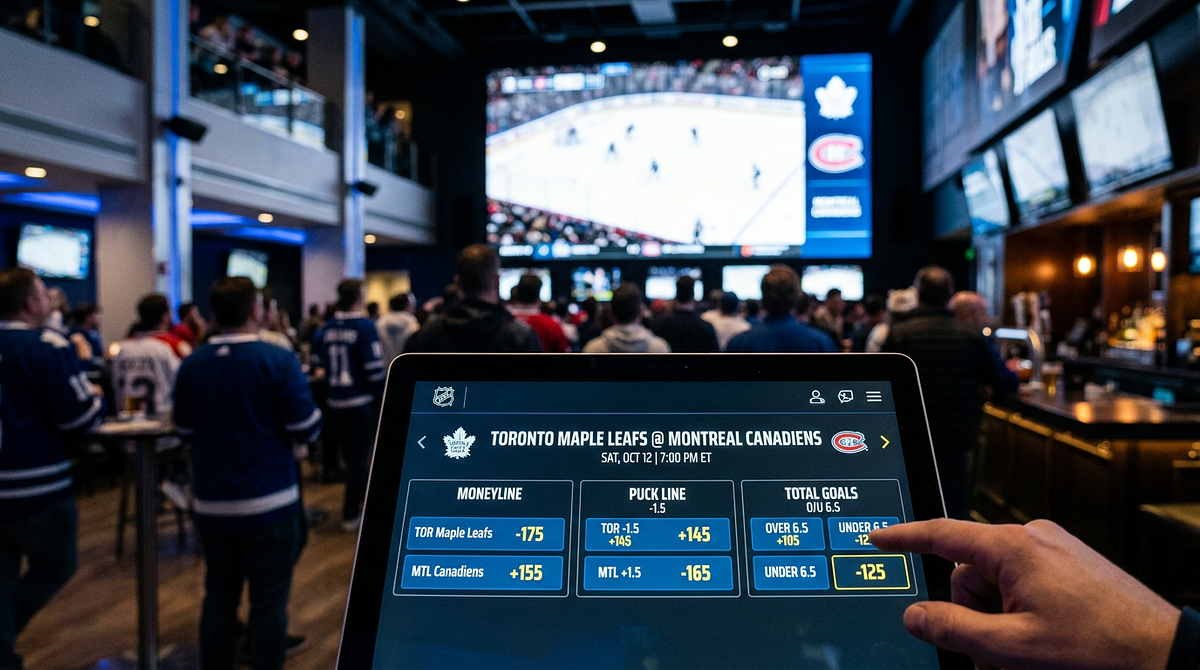
This page covers the three main ways to bet NHL games in Canada: the moneyline, the puck line, and total goals. You’ll find all three markets side by side on every game at licensed sportsbooks and provincial platforms like OLG PROLINE+ and BCLC PlayNow. They’re connected, not separate. The handicap built into the puck line directly affects which side looks favoured compared to the moneyline. By the end of this page, you’ll be able to read all three prices together and decide which market fits the bet you want to make.
The Three Core NHL Markets at Canadian Sportsbooks
Every NHL game at a Canadian sportsbook comes with three markets priced as a set: the moneyline, the puck line, and total goals. Each one asks a different question about the same game: who wins outright, who wins by a specific margin, and how many goals both teams combine to score. Private Canadian sportsbooks show these prices in American odds format, where favourites carry negative numbers and underdogs carry positive numbers. Provincial lottery betting products show the same markets in decimal odds format, so the numbers look different depending on where you place your bet.
Why These Three Markets Are Always Priced Together
These three markets exist as a set because each one isolates a different variable in the same game: outcome, margin, and combined scoring. If you only understand one of the three, you’re missing part of the picture. A team’s moneyline price is not the same as its puck line price, because the puck line adds a fixed ±1.5 goal handicap that changes the probability being priced. The gaps between the three markets reflect how the sportsbook models the game, not inconsistency in the pricing. Once you see how they connect, you can read a hockey slate accurately instead of treating each market as an unrelated number.
Moneyline Betting on the NHL
The moneyline is the most straightforward of the three markets. You’re simply picking which team wins the game. There’s no margin requirement: a one-goal win settles the same as a five-goal win. In the NHL, the moneyline includes overtime and shootouts, so a tie is never a possible outcome. That’s why the standard NHL moneyline only has two prices, one for each team, with no draw option listed.
How Moneyline Odds Are Priced
Canadian private sportsbooks show moneyline odds in American format. Negative numbers identify the favourite and positive numbers identify the underdog. The size of the number reflects how likely the sportsbook thinks each team is to win. A larger negative number means a stronger favourite; a larger positive number means a bigger underdog.
Say the favourite is priced at -180 and the underdog at +150. A C$180 bet on the favourite returns C$100 in profit if that team wins, plus your C$180 stake back, for a total payout of C$280. A C$100 bet on the underdog at +150 returns C$150 in profit if that team wins, for a total payout of C$250. Neither price is a recommendation. Each one is a probability signal encoded as a number. Reading the moneyline this way lets you assess implied probability rather than just react to which number looks bigger.
The 60-Minute (3-Way) Moneyline Variant
The 60-minute moneyline, also called the 3-way moneyline, is a separate market that settles on the result after regulation only. It offers three possible outcomes: home win in regulation, away win in regulation, or a tie after 60 minutes. Because a tie is now a real outcome rather than an impossible one, the sportsbook prices all three sides. The prices on the home and away options will be different from those on the standard moneyline for the same game.
If you see two separate moneyline prices listed for the same NHL game, that’s not a pricing error. The two prices correspond to two different questions: one that includes overtime and shootouts, and one that doesn’t. Knowing this prevents you from placing a bet under the wrong settlement assumptions.
The Puck Line, Hockey’s Version of the Point Spread
The puck line is hockey’s version of the point spread. Its defining feature is a fixed handicap of ±1.5 goals applied to virtually every NHL game. Unlike point spreads in football or basketball, which shift up or down based on the matchup, the puck line number stays constant. The sportsbook adjusts the odds on each side rather than moving the spread itself. Canadian provincial lottery products like OLG PROLINE+ and BCLC PlayNow label this market as “spread” or “handicap” rather than “puck line,” but the mechanic is identical across all platforms.
How the ±1.5 Puck Line Settles
The favourite is listed at -1.5 and must win by 2 or more goals to cover. The underdog is listed at +1.5 and covers by either winning outright or losing by exactly 1 goal. A game sitting at a 1-goal margin in the third period is still a live puck line decision regardless of which team is ahead, because a single goal in either direction changes how the bet settles.
The ±1.5 handicap resolves in exactly four ways, and knowing them lets you read a live scoreline correctly.
- Favourite wins by 2 or more goals: -1.5 side covers; +1.5 side loses.
- Favourite wins by exactly 1 goal: -1.5 side loses; +1.5 side covers.
- Underdog wins outright: +1.5 side covers; -1.5 side loses.
- Underdog loses by exactly 1 goal: +1.5 side covers; -1.5 side loses.
Why Puck Line Odds Move Instead of the Spread Number
Because the ±1.5 spread is fixed, sportsbooks express how lopsided a matchup is by moving the odds on each side, not the number itself. Winning by 2 or more goals is harder than simply winning, so the odds on the -1.5 side are always less favourable than the moneyline price for the same team.
A heavy moneyline favourite priced around -180 will typically become a plus-money price like +130 on the -1.5 puck line, because the margin requirement makes covering harder than winning outright. That same underdog priced at +150 on the moneyline will typically become a minus-money price like -180 on the +1.5 puck line, because the 1-goal cushion increases the probability of that side covering. You’ll see the favourite carrying a negative moneyline price and a positive puck line price at the same time. That’s not a contradiction or a pricing error. It’s a direct result of the fixed spread mechanic. The odds difference between the two markets encodes that asymmetry directly.
Overtime, Shootouts, and Empty-Net Goals
Puck line bets settle including overtime and shootouts, and this creates two structural consequences that make the final minutes of regulation and the start of overtime decisive. Once a game reaches overtime, the -1.5 favourite side cannot win. The next goal ends the game at a 1-goal margin, which means the favourite has won by exactly 1, a result that loses the -1.5 bet. The +1.5 underdog side is guaranteed to cash the moment overtime begins, because no overtime or shootout result can produce a 2-goal margin for the favourite.
Late empty-net goals in regulation carry the same weight. A goal that extends a 1-goal lead to 2 goals in the final minute directly determines whether the -1.5 side covers. If you understand this, you’ll read a tight late-regulation game, and the moment overtime begins, as significant for the puck line, not just as game action.
Alternate Puck Lines and Period Puck Lines
Most sportsbooks offer alternate puck lines at ±2.5 or greater, with odds shifting significantly for each additional goal added or removed from the spread. Taking the favourite at -2.5 means accepting a harder margin requirement in exchange for a higher return. Taking the underdog at +2.5 means accepting lower odds in exchange for a wider cushion. Period puck lines apply a -0.5/+0.5 spread within a single period rather than the standard 1.5, meaning the favourite must win that period outright and the underdog covers by either winning the period or drawing it. Both variants work on the same fixed-spread, variable-odds mechanic as the standard puck line, so if you understand the base market, you can read these alternatives without treating them as separate systems.
Total Goals, Over/Under Betting on the NHL
The total goals market, commonly called the Over/Under, asks you to bet on whether the combined final score of both teams goes over or under a number the sportsbook sets before the game. Most NHL totals fall between 5.0 and 6.5 goals, with the specific number reflecting the sportsbook’s read on the offences and defences involved in that matchup. Totals settle including overtime and shootouts, so the game’s final posted score, not the score at the end of regulation, determines the outcome.
How Totals Are Priced and Settled
The total number is paired with separate odds for the Over and the Under, and those two prices aren’t always equal. Whether the total is set at a half-goal number like 5.5 or a whole number like 6.0 determines whether a push is possible. A half-goal total eliminates push risk entirely, because no combined score can land exactly on a non-integer. The bet settles as a win or a loss with no middle outcome. A whole-number total introduces push risk: if the sportsbook sets a game at 6.0 and the final combined score is exactly six goals, both the Over and the Under are refunded.
Take a game with a total of 6.0, where the Over is priced at -115 and the Under at -105. The bettor taking the Over at -115 pays slightly more per unit of potential profit than the bettor taking the Under at -105, which signals the sportsbook’s slight lean toward the Under at that number. If the final score is 4-2, the combined total is six, a push, and both sides get their stakes back. If the final score is 4-3, the combined total is seven, and the Over cashes. Checking whether the total is a half-goal or whole number is the first thing to do before reading the prices alongside it.
How Overtime and Empty-Net Goals Affect Totals
Overtime and shootout scoring counts toward the total. In a shootout, one goal is added to the winning team’s score for settlement purposes, so a game tied 2-2 after regulation and decided by a shootout settles as a 3-2 final, a combined total of five goals. Late empty-net goals in regulation carry the same weight. A goal scored into an empty net in the final minute can move a game from four combined goals to five, directly flipping an Under to an Over or pushing a game sitting exactly on a whole-number total.
If you understand this, you’ll treat the closing minutes of regulation and the start of overtime as live for the total, not as incidental game action. Once a game enters overtime tied at a score that already exceeds the total, the Over is already settled. If the combined score entering overtime sits one goal below the total, the single goal that ends the game in overtime, or the shootout goal added to the winner’s tally, determines the outcome.
The Grand Salami, Combined Daily Total
The Grand Salami is a totals market covering the combined goals scored across every NHL game on a given day’s schedule. The sportsbook sets a single Over/Under number for the entire slate. Instead of asking how many goals one specific game produces, it asks how many goals all games that day produce in total. The same settlement rules that apply to individual game totals, including overtime and shootout goals, push risk on whole-number totals, and no push risk on half-number totals, apply to the Grand Salami. If you understand the individual game Over/Under, you can read the Grand Salami as that same structure scaled to a full slate.
Comparing the Three Markets on the Same Game
The three prices on any NHL game aren’t independent quotes. They’re a set of internally consistent signals that together describe what the sportsbook expects from the matchup. The moneyline encodes win probability, the puck line encodes expected margin, and the total encodes expected combined scoring. Reading all three on the same game lets you identify the implied narrative. A heavy favourite with a low total suggests a defensive game decided by one goal. A heavy favourite with a high total suggests a high-scoring blowout. These relationships are structural, not coincidental.
Side-by-Side Comparison of Moneyline, Puck Line, and Total Goals
You can evaluate each of the three markets across the same four dimensions: what the wager settles on, whether a margin requirement applies, whether a push is possible, and how overtime and shootout scoring affect settlement. Mapping all three markets against these dimensions shows where they share mechanics and where they part ways.
| Dimension | Moneyline | Puck Line | Total Goals |
|---|---|---|---|
| What the wager settles on | Outright winner | Winner by margin | Combined goals scored |
| Margin requirement | None | ±1.5 goals (fixed) | None (over/under a set number) |
| Push possible in NHL play? | No (overtime/shootout decides) | No (half-goal spread eliminates ties) | Yes, on whole-number totals only |
| Overtime and shootout included? | Yes | Yes | Yes |
| Typical Canadian labelling on lottery products | Moneyline | Spread / Handicap | Total (O/U) |
Canadian Sportsbook Conventions for NHL Markets
Canadian bettors access the moneyline, puck line, and total goals markets through two distinct channels: private, provincially licensed sportsbooks and provincial lottery betting products. Both channels offer the same three underlying markets, but they label them differently and display odds in different formats. If you move between the two channels for the first time, you’ll see the same game priced in a different numeric format, which can cause misreadings if you don’t recognize the difference before interpreting the numbers. A specific team makes these markets concrete. Puck lines and totals as they apply to the Maple Leafs is a good place to see the theory in practice.
Private Sportsbooks vs. Provincial Lottery Products
Private Canadian sportsbooks default to American odds, where a negative number identifies the favourite and a positive number identifies the underdog. They use the term “puck line” to label the ±1.5 goal handicap market. Provincial lottery betting products across the country default to decimal odds, where the number shown represents the total return per C$1 wagered including the original stake. They label the same ±1.5 goal market as “spread” or “handicap” rather than “puck line.” The two formats encode identical probability information in different numeric structures, so the underlying market mechanic doesn’t change between channels. Only the presentation does.
| Dimension | Private Canadian sportsbooks | Provincial lottery sport-betting products |
|---|---|---|
| Default odds format | American (plus/minus) | Decimal |
| Terminology for the ±1.5 goal market | Puck line | Spread / Handicap |
| Typical bet structure | Single-game and parlay available | Parlay-style (multiplied odds) on most lottery products |
Historical Context on Favourite and Underdog Performance
Across 15 NHL seasons, favourites returned -1.6% ROI on the moneyline versus -2.8% ROI on the puck line, while underdogs returned -1.8% ROI on the puck line odds versus -2.4% ROI on the moneyline. [VERIFY THIS QUOTE] These figures are descriptive historical averages, not a prescription for how to bet. What they confirm is that the pricing gap between a team’s moneyline price and its puck line price reflects a real structural difference in difficulty. Winning by two or more goals is measurably harder than winning outright, and the 1-goal cushion on the underdog side carries real probability value. When you see a team carrying a negative moneyline price and a positive puck line price at the same time, that’s not a contradiction. The odds difference between the two markets encodes that asymmetry directly.
Reading a Canadian NHL Card With All Three Markets in View
Each of the three markets on an NHL game prices a different question about the same event. Reading them as a set turns a hockey slate from a row of unrelated numbers into a coherent picture of how the sportsbook models the matchup. A team carrying a negative moneyline price and a positive puck line price on the same game isn’t a contradiction. It’s the fixed ±1.5 goal handicap doing exactly what it’s designed to do, shifting the probability being priced. Once you understand that relationship, you can read any Canadian NHL card accurately, whether the odds appear in American format on a private sportsbook or in decimal format on a provincial lottery product.