


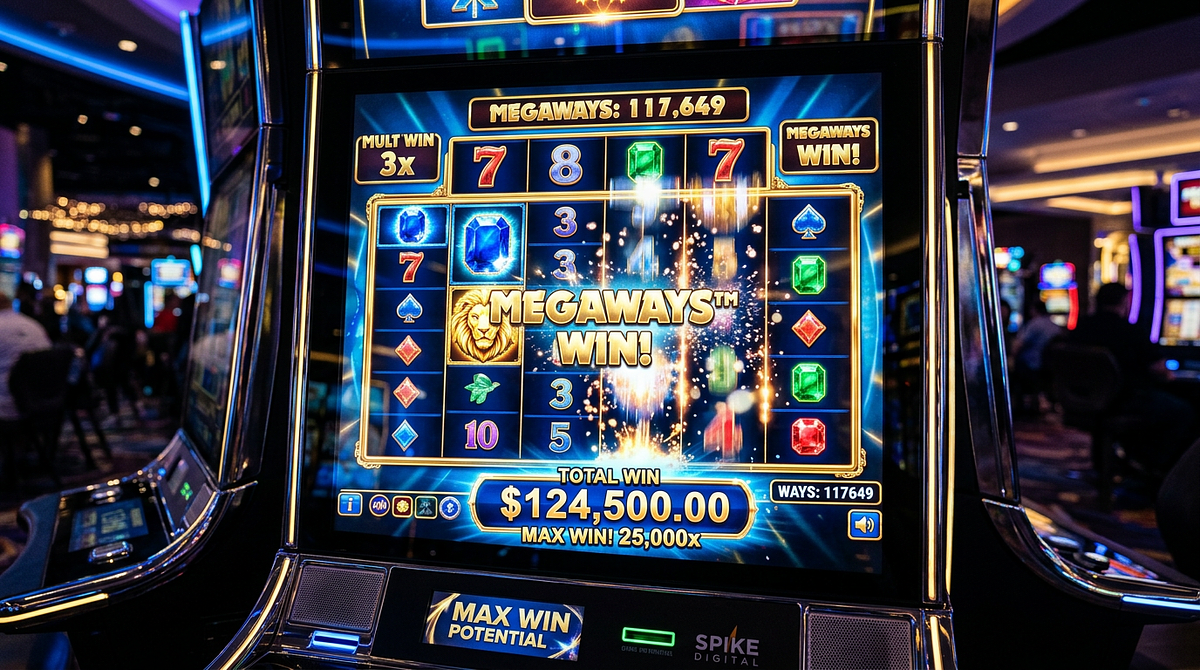
This page covers how the Big Time Gaming Megaways mechanic works and how max wins are calculated. The variable reel-height system drives between 64 and 117,649 ways to win on a standard six-reel setup. We’ll walk through the reel math behind that range, then cover cascading wins, free-spin multipliers, RTP, and volatility, showing how each factor feeds into theoretical maximum win figures. By the end, you’ll have a clear basis for judging which outcomes are realistically within reach and which are just mathematical ceilings.
Origins of the Variable Reel Mechanic
Megaways is a patented mechanic created by Big Time Gaming (BTG), an Australian slot studio founded in Sydney in 2011 and based in Surry Hills, New South Wales. Nik Robinson founded the company and serves as CEO, with Huw McIntosh handling technical direction and Ian Schmidt creative direction. The mechanic first appeared in Dragon Born in 2016, which BTG describes as a world-first in math design, and it reached mainstream play later that year with the release of Bonanza.
How Ways to Win Are Calculated Each Spin
The variable reel mechanic replaces fixed paylines with a system where each of the six reels independently and randomly shows between 2 and 7 symbols on every spin. The ways-to-win count isn’t a fixed property of the game. It’s recalculated the moment the reels stop. The math is simple: multiply the visible symbol counts across all six reels.
Because each reel’s height is randomised on its own, those six values change from spin to spin, and so does the result.
The Multiplication Rule and Its Boundary Values
The ways-to-win count comes from multiplying the number of visible symbols on reel 1 by the number on reel 2, and so on through reel 6. At the low end, when every reel shows the minimum of 2 symbols, the calculation is 2×2×2×2×2×2 = 64 ways. At the high end, when every reel shows the maximum of 7 symbols, it’s 7×7×7×7×7×7 = 117,649 ways.
Hitting both extremes at the same time is statistically uncommon. A more typical result is an uneven configuration like 5×4×6×7×3×5, which gives 12,600 ways to win. Those middle-ground values are the norm.
The game doesn’t guarantee 117,649 ways on any spin. That number is the ceiling of a random distribution, not a stable state. Each spin generates a new set of reel heights from scratch, so the active way count is a fresh random draw every time.
Why More Active Ways Do Not Improve Hit Frequency or RTP
A higher ways-to-win count on a given spin doesn’t increase how often you hit a win, and it doesn’t change the game’s RTP. Those properties are fixed by the underlying math model and don’t shift based on how the reels land.
Hit frequency, volatility, and RTP are set by the symbol weightings on the reel strips, the pay table, and the bonus math. The way count is just a snapshot of how many symbol paths exist across the visible grid at that moment. It doesn’t tell you how likely those paths are to contain a winning combination. A spin that lands on 117,649 active ways is drawn from the same probability distribution as one that lands on 64.
Cascading Reactions Within a Single Spin
After a winning combination pays out, the symbols that formed it are removed from the grid. The empty spots are then refilled, either by new symbols dropping from above or shifting in from the sides, depending on how the game handles it. That refill can form a new winning combination, which pays out and triggers the same removal-and-replacement process again. The chain keeps going until a refill produces no new wins, and then the spin ends.
In most versions of the mechanic, reel heights are re-evaluated on each cascade rather than staying fixed at the values from the initial drop. Each stage of the sequence can show a different symbol count per reel, so the ways-to-win figure recalculates each time. A single spin can pass through several different ways-to-win totals, sometimes jumping into six figures on one cascade and dropping sharply on the next, before the sequence resolves.
How Max Wins Are Calculated and Why They Are Theoretical
The max win figures you see for Megaways titles are theoretical ceilings based on the permutation space of the reel strips. They’re not fixed jackpots or guaranteed payouts. Reel strips with 150 or more symbols per reel produce permutation counts in the billions, which puts the maximum outcome deep in the tail of the probability distribution, well outside the range of normal play.
The main path toward those ceilings is the free-spins feature, where escalating multipliers stack up across cascade wins throughout the round. Some titles set a hard total-win cap expressed as a multiple of stake. Others publish no cap and are described as theoretically unlimited. The differences between those structures are explained below.
The Statistical Nature of the Maximum
The max win figure for a Megaways title is the largest outcome the game’s math model can produce. It’s not a target that regular play moves toward. Hitting it requires a specific alignment of high-value symbols across multiple cascades in a free-spins round, with the persistent multiplier at a high value when those cascades resolve. The combined probability of that happening is extremely low.
Community player-tracking discussion has noted that although Megaways titles can pay well above 15,000x stake in principle, the probability of any single session exceeding even 500x is described as very low. That puts the gap in perspective: the “max ways” figure of 117,649 is the upper bound of the math model, while the realistic ceiling for most sessions is far lower. The two numbers describe different things.
The Role of Escalating Free-Spin Multipliers
Many Megaways titles apply a persistent, increasing win multiplier during the free-spins round. It typically starts at 1x and goes up with each cascade or each spin, and it doesn’t reset during the feature. Long cascade sequences can push the multiplier into values that drive cumulative wins toward the theoretical ceiling.
The multiplier, not the base game, is the main mathematical driver of big payouts in this format. Base-game wins make up a fraction of long-run RTP, but the big end of the win distribution is dominated by free-spin sessions where the multiplier climbs into double or triple digits before the round ends. Some titles let you extend the free-spins count through gamble features or retriggers, which gives the multiplier more cascades to build through and increases the compounding potential. Players in Canada’s most developed regulated market can find many of these titles available through Ontario’s licensed online casino operators, where game libraries tend to be broad and regularly updated.
Capped Versus Uncapped Win Structures
Titles in this format split into two categories when it comes to maximum payout. The first type has a hard total-win cap, a ceiling stated in the paytable as a multiple of stake, beyond which the game won’t pay regardless of how the math resolves. The second type has no such cap. Bonanza and Extra Chilli are described in community player-tracking discussion as having theoretically unlimited win potential.
“Uncapped” doesn’t mean the wins are actually unlimited. Uncapped titles are still bounded by their math model. The reel strips, symbol weightings, and multiplier progression define a distribution whose upper reaches are vanishingly rare, even without an artificial ceiling on top.
Comparative Data Across Core Titles in the Format
Most original titles built on this variable reel-height system by BTG share the same 117,649 maximum ways configuration and are classified as high volatility. The meaningful differences are elsewhere: the published RTP variant, how the bonus triggers, and whether the paytable states a hard total-win cap.
The comparison below looks at those specification-level differences across four core originals, with a note on the one title that breaks the standard ceiling.
Title-Level Comparison Table
The table below lets you compare the technical specs that shape win behaviour across the developer’s core original titles in the format.
| Title | Max Ways | Standard RTP | Volatility | Bonus Trigger Type | Win Cap Status |
|---|---|---|---|---|---|
| Bonanza Megaways (2016) | 117,649 | 96.00% | High | Scatter-triggered free spins from the base game | No hard win cap published in the paytable |
| Extra Chilli Megaways | 117,649 | 96.82% | High | Gamble feature for free-spin entry; up to 24 free spins available | No hard win cap published in the paytable |
| Who Wants to Be a Millionaire Megaways | 117,649 | 96.24% | High | Licensed quiz-show adaptation; scatter-triggered free spins | Total-win cap applied per licensed-content requirements |
| White Rabbit Megaways | 248,832 | Approximately 97.72% (most commonly published variant) | High | Free spins with extending reels via Cake symbols | Total-win cap stated in the paytable |
Regulator-approved RTP variants exist for titles in this format. The figures above reflect the most commonly published standard variant, and operators in specific jurisdictions may run a lower-RTP build.
Titles That Exceed the Standard 117,649 Ceiling
A small number of titles in this format use an expanded reel configuration that pushes the maximum ways figure above the standard six-reel by seven-symbol ceiling. White Rabbit Megaways is the clearest example, reaching 248,832 ways to win. That higher number comes from Cake symbols collected during the free-spins feature, which add two extra symbol positions to the reels and push reel height beyond the standard seven-symbol maximum. Once the reels are fully extended, multiplying the visible symbols across the grid gives 248,832 rather than 117,649.
This is an exception tied to a specific in-feature mechanic, not the standard for titles in the format.
Licensing and the Wider Family of Titles
The variable reel mechanic is patented and trademarked by Big Time Gaming. Third-party developers can only use it through a specific licensing arrangement. In 2018, BTG signed a deal giving Blueprint Gaming the rights to build titles using the mechanic, which produced the broader catalogue of externally developed games carrying the Megaways name. More licensees followed under similar revenue-share terms.
BTG’s ownership changed in 2021, when Evolution announced its acquisition of Big Time Gaming on 12 April and completed the deal on 30 June that year. One practical point worth knowing: a casino’s catalogue of titles using this mechanic is not the same as its catalogue of titles made by Big Time Gaming. The two sets overlap, but they’re not identical. Players looking to access the full range of licensed Megaways titles through a regulated platform may find it useful to review how British Columbia’s online casino market is structured, since PlayNow and offshore options differ significantly in their available game libraries.
Related Proprietary Mechanics from the Same Developer
Beyond Megaways, Big Time Gaming has developed several other proprietary mechanics across its portfolio. These include Megaclusters, a cluster-pays engine built on a subdividing symbol grid; Megapays, a linked progressive jackpot framework layered onto base-game math; Megaquads, a multi-grid mechanic that resolves several slot grids within a single spin; Megapots, a jackpot-distribution structure tied to in-game triggers; and Megadozer, a coin-pusher-style mechanic adapted to slot format.
Megaquads is the most extreme scaling of the ways-to-win concept in the developer’s catalogue. By merging multiple slot grids into a single spin resolution, it produces a permutation space that can reach up to 16 million potential ways-to-win combinations, an order of magnitude beyond the 117,649 ceiling of the standard six-reel Megaways setup. For players in provinces with regulated iGaming markets, understanding how Alberta’s online casino framework handles access to these newer game formats is worth checking before registering with any platform.
What the 117,649 Figure Really Tells You
Two slots can share the 117,649 ways ceiling and still sit at opposite ends of the volatility spectrum. That gap matters far more to your session than the ways count ever will. The figure marks a maximum, not an average, so treating it as a measure of how generous a game is misreads what it describes. RTP, volatility, and win-cap structure are what shape real payout behaviour, and those vary sharply even among titles with identical way counts. If you want to put that understanding to work, browsing slots filtered by volatility and RTP range is a more useful approach than comparing ways figures alone.
We check operator terms, licences and payment details against the casino's own pages and update this content when they change. Read our editorial policy, our transparency statement, or report an error. If gambling stops being fun, see our responsible gambling resources.