
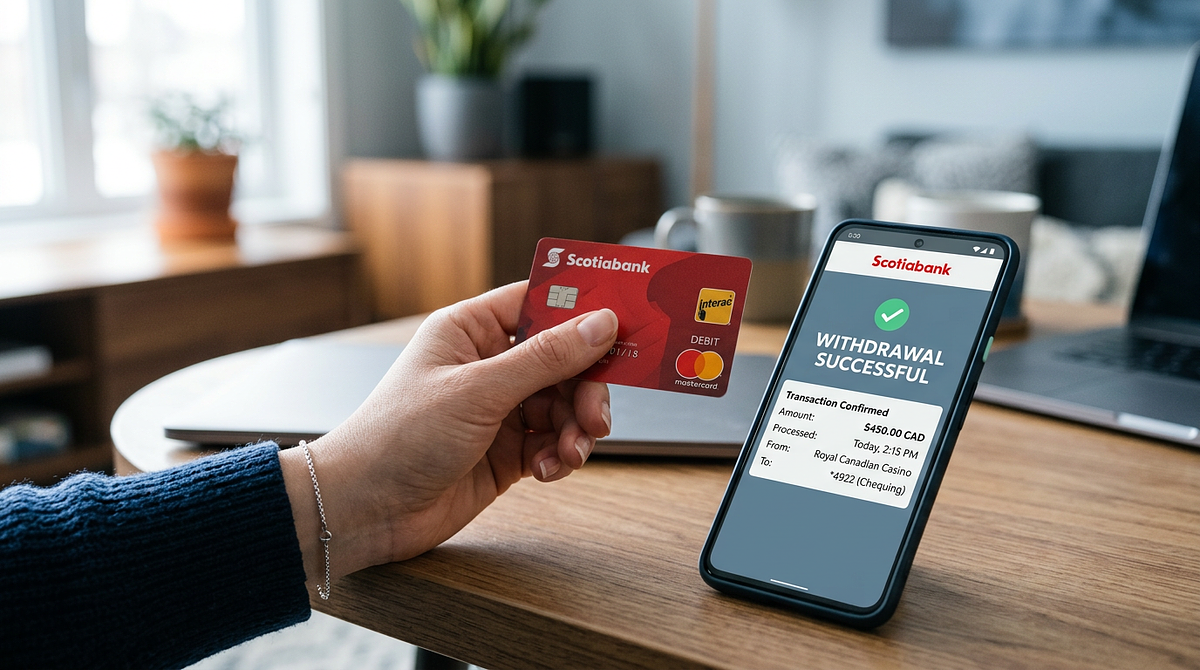
If you’re comparing BlueChip and Jackpot City on Canadian banking options, the answer matters more than you might think. It affects currency conversion fees, which domestic payment methods are available, and how long withdrawals actually take to land. This page breaks down both operators across the factors that count most: Interac support, native CAD handling, and post-approval processing times. By the end, you’ll know which operator has broader domestic payment coverage and where the evidence on cashout speed is solid versus incomplete.
Regulatory Standing of Each Operator in Canada
The licence an operator holds in Canada directly shapes which payment methods it can offer, how withdrawals are governed, and which rules apply to which players. Canada’s online gaming market isn’t run by a single national regulator. One provincial body covers a single province under its own rules, while a separate gaming commission covers players in the rest of the country under a different framework. Knowing which framework applies to each operator is the foundation for everything in the banking comparison below.
Licensing Framework Covering Jackpot City
Jackpot City operates under the corporate entity Cadtree Limited, which appears on the iGaming Ontario registry of registered internet gaming operators. The Alcohol and Gaming Commission of Ontario (AGCO) is the provincial regulator for Ontario players under that registration. For players outside Ontario, Jackpot City holds a Kahnawake Gaming Commission licence, number 00892, which operates under a separate jurisdictional framework. This dual-jurisdiction structure has a direct practical consequence: Ontario players and players in the rest of Canada are subject to different promotional terms. The welcome bonus, for example, applies only to rest-of-Canada players, with Ontario excluded. The same split also determines which payment methods are permitted per jurisdiction, so your province of residence shapes both the promotional and payment environment you’ll encounter.
Licensing Framework Covering BlueChip
The available research doesn’t document any Canadian regulatory standing for BlueChip. No provincial regulator, gaming commission, or licence identifier for BlueChip appears in the sources reviewed. The iGaming Ontario registry of registered operators does not list BlueChip or an associated corporate entity. Based on the available evidence, it’s not possible to verify whether BlueChip holds equivalent Canadian regulatory coverage to Jackpot City, whether it operates under a separate offshore framework, or what jurisdictional rules govern its Canadian-facing operations. This is a factual gap in the available information, not a determination of legitimacy or risk.
Canadian Deposit Methods Compared
Deposit method coverage at Canadian-facing online casinos breaks down across four categories: the domestic bank-transfer network, major international card schemes, mobile wallet options, and e-check or bank-wire methods. The analysis below covers deposit availability only. Withdrawal method coverage and cashout processing windows are addressed in the next section. Specific method names and provider details are covered below.
Deposit Method Coverage Across Both Operators
To compare deposit breadth, you need to look at each operator across four categories: domestic real-time payment method, international card schemes, mobile wallet, and e-check or bank transfer. The research documents specific methods for Jackpot City across all four categories. No equivalent documentation exists for BlueChip in the available sources, and the table below reflects that gap directly rather than assuming the two are comparable.
| Deposit Category | Jackpot City | BlueChip |
|---|---|---|
| Domestic real-time payment method | Interac | Not documented in available sources |
| International card scheme 1 | Visa | Not documented in available sources |
| International card scheme 2 | Mastercard | Not documented in available sources |
| Mobile wallet | Apple Pay | Not documented in available sources |
| E-check | eCheck | Not documented in available sources |
| Bank wire | Bank wire transfers | Not documented in available sources |
Domestic Payment Rail Provider Integrations
The number of providers behind a domestic real-time payment method tells you something about how reliable that method is likely to be. When an operator connects to the same payment method through multiple distinct providers, there’s a backup if one provider goes down. Multiple provider connections also suggest the operator has built its payment setup to handle higher transaction volumes without a single point of failure.
Jackpot City documents two distinct Interac provider connections: Payper Inc. handles fast deposits, while Gigadat handles larger withdrawals. The payment gateway routes settlements through Canada’s Big Five banks: BMO, CIBC, RBC, TD, and Scotiabank. That gives it broad domestic banking coverage. No equivalent provider data is documented for BlueChip in the available sources, and no assumption of comparable infrastructure is warranted from the evidence at hand.
Withdrawal Methods and Cashout Speed
Withdrawal options and processing speed matter more to most players than deposit options, because deposits settle almost instantly across nearly all methods while withdrawal timing varies a lot by method and operator. The comparison below covers three things: which withdrawal methods each operator offers, the processing timeframes documented by method category, and the compliance step that must be cleared before any first payout is released.
Withdrawal Rail Availability by Operator
The key question here is whether each operator offers the same methods for withdrawals as it does for deposits, or whether certain methods are restricted to specific withdrawal size tiers. The research documents a size-tier split for Jackpot City: eCheck is used for smaller withdrawal amounts, while bank wire is reserved for larger cashouts. No equivalent withdrawal method data exists for BlueChip in the available sources, and the table reflects that gap directly.
| Withdrawal Method | Jackpot City | BlueChip | Size Tier (if applicable) |
|---|---|---|---|
| Domestic real-time payment method | Interac | Not documented in available sources | No tier restriction documented |
| International card scheme (return-to-source) | Not documented in available sources | Not documented in available sources | Not applicable |
| E-check | eCheck | Not documented in available sources | Smaller withdrawal amounts |
| Bank wire | Bank wire | Not documented in available sources | Larger cashout amounts |
Processing Timeframes by Withdrawal Category
A withdrawal timeline has two separate windows. The first is the pending or approval window, where the operator reviews and approves the request. The second is the post-approval settlement window, where the funds move through the payment method to your account. Operators usually only publish one of these windows in their documentation, which means a quoted timeframe can understate the total time to funds. The real total is the sum of both windows, not just one.
The following timeframes apply to Jackpot City, the operator for which the research documents specific figures. Equivalent figures for BlueChip are not available in the research and should not be assumed.
- Domestic real-time method and e-wallet withdrawals: 24 to 48 hours post-approval.
- Bank wire withdrawals: up to 3 business days post-approval.
- Overall post-approval window: 24 to 72 hours across all methods.
The Compliance Step That Gates First Withdrawal
Before an operator releases your first withdrawal, you have to complete identity verification. This isn’t just operator policy. It’s driven by Canadian federal anti-money-laundering rules administered by FINTRAC (Financial Transactions and Reports Analysis Centre of Canada). That distinction matters when you’re trying to figure out why a first cashout is slow. A delayed first withdrawal is usually a verification-processing issue, not a sign that the payment method itself is slow. Once your identity is verified, subsequent withdrawals don’t go through the same identity-check step, so the processing windows above apply from your second withdrawal onward.
Native Currency Handling and Conversion Exposure
Having a lot of payment methods and supporting native currency are two different things. An operator can offer Interac, Visa, Mastercard, and eCheck while still holding player balances in a non-domestic currency and applying a conversion fee on every deposit and withdrawal. This section looks at whether each operator holds player balances in CAD and whether transactions cross a conversion boundary. Those are separate questions from how many payment methods are available.
Domestic Currency Support Across Both Operators
Jackpot City documents CAD support across all payment options. In practice, that means no conversion fee is applied at deposit or withdrawal, and your balance is held in the same currency your bank uses. No equivalent currency documentation exists for BlueChip in the available sources. Whether BlueChip holds balances in CAD or applies a conversion at the point of deposit is not established by any retrieved source. That gap has a specific practical consequence: if you’re comparing a headline bonus figure between two operators, the one without confirmed native-currency support presents a bonus amount whose real CAD value depends on whatever conversion rate gets applied at deposit. The stated amount and the effective amount may not be the same.
The Domestic Bank Network Behind Settlements
Jackpot City’s payment gateway routes settlements through Canada’s Big Five banks: BMO, CIBC, RBC, TD, and Scotiabank. Settlement through these institutions is a reasonable signal of reliable clearing. These banks operate under federal prudential oversight and maintain the processing infrastructure that reduces the likelihood of held or reversed transactions at the receiving institution. No equivalent bank-routing documentation exists for BlueChip in the available sources.
Direct Verdict on Canadian Banking Breadth
Jackpot City has documented coverage across six deposit and withdrawal methods: Interac, Visa, Mastercard, Apple Pay, eCheck, and bank wire. It also has confirmed native CAD support and dual-jurisdiction regulatory standing under both the AGCO and the Kahnawake Gaming Commission. No retrieved source documents any Canadian banking option, payment method, currency handling, or regulatory status for BlueChip. A direct head-to-head comparison across all four evaluation criteria isn’t possible from the available evidence. The verdict below reflects that gap rather than assuming the two operators are on equal footing.
Head-to-Head Summary Across Evaluation Criteria
The summary below weighs four criteria: method breadth, cashout speed, native currency support, and regulatory documentation. Each cell is filled using only what the available research documents for each operator. Where no source documents a criterion for a given operator, the cell says so directly.
| Evaluation Criterion | Jackpot City | BlueChip |
|---|---|---|
| Domestic method coverage | Interac (deposit and withdrawal), eCheck, bank wire, Visa, Mastercard, Apple Pay | Not documented in available sources |
| Cashout speed range | 24-48 hours post-approval for Interac; up to 3 business days for bank wire; 24-72 hours overall | Not documented in available sources |
| Native currency handling | All payment options support CAD; no conversion fees applied at deposit or withdrawal | Not documented in available sources |
| Canadian regulatory documentation | AGCO registration (Ontario) under Cadtree Limited; Kahnawake Gaming Commission licence 00892 (rest of Canada) | Not documented in available sources |
| Overall verdict on Canadian banking breadth | Broader documented Canadian banking stack across all four criteria | Cannot be assessed; no Canadian banking data available in retrieved sources |
How to Read a Canadian Casino’s Banking Page Before You Fund an Account
Jackpot City’s split between its Ontario AGCO registration and its Kahnawake licence for the rest of Canada isn’t a technicality. It determines which payment methods and promotional terms apply to you, and it’s the kind of detail a banking page’s logo grid will never show on its own. Jackpot City’s dual Interac provider setup, routing deposits through Payper Inc. and larger withdrawals through Gigadat across Canada’s Big Five banks, is a concrete example of what redundant payment infrastructure looks like in practice. It’s a useful benchmark when sizing up any operator’s domestic payment claims. Native CAD support matters in the same way: a headline bonus figure at an operator without confirmed CAD denomination carries a real-value uncertainty that only resolves once you know the conversion rate applied at deposit. If you want to apply this same lens to other Canadian-facing operators, our full breakdown of Canadian casino banking options is a practical place to continue. See our full review of its live betting markets and odds, and the full BlueChip Casino review.